

The unseen poem is a compulsory task appearing in Section III (Poetry) on Paper 2 at Higher Level. It carries 20 marks out of the 70 marks allocated to poetry, with the remaining 50 marks awarded to your studied prescribed poet. On recent examination papers, the unseen poem is divided into two compulsory questions, part (a) and part (b), worth 10 marks each. You are not expected to have any prior knowledge of the poet or their background; everything required to succeed is printed on the examination paper. Examiners look for an authentic, independent response that directly answers the prompt using sharp textual evidence and close analysis of poetic craft.
The 20-Minute Strategy: Read, Target, and Manage Time
Under examination conditions, budget exactly 20 minutes for Section III Part A. A disciplined approach prevents you from eating into the time needed for your prescribed poet or comparative essay.
Allocate Your Time
Spend roughly 5 minutes reading and annotating the poem, leaving approximately 7 to 8 minutes of writing time for each 10-mark question. Do not rush straight into writing; a few minutes of close reading ensures you grasp the poet's ideas rather than falling into superficial summary.
The Three-Reading Routine
- First Reading: Read the poem straight through without stopping over difficult phrases. Identify the persona (the speaker of the poem, who may not be the poet) and establish the basic situation, subject, and atmosphere.
- Second Reading: Read with a pen in hand. Circle striking verbs, vivid adjectives, sound patterns, and shifts in feeling or perspective.
- Third Reading: Read the specific questions on the paper carefully. Scan back through the text to underline two or three short quotations that directly answer each prompt.
Practise this routine using past examination papers from 2020 to 2025. Always refer to the writer by their surname and refer to the piece by its title.
Recognising Common Question Types
Leaving Certificate Higher Level unseen questions consistently test a small set of recurring categories. Identifying the question type allows you to structure your response quickly:
Title Questions
When asked whether a title is suitable, impactful, or appropriate, explain what the title means literally, explore what deeper meaning it acquires by the end of the poem, and link it directly to at least two specific moments in the text.
Tone and Mood Questions
Name the tone (the speaker's attitude) or the mood (the emotional atmosphere created for the reader) using precise adjectives such as reflective, melancholic, caustic, or poignant. Trace any shift or volta across the poem, such as an opening that feels playful before turning sombre.
Impression of a Character or Speaker
If asked what impression you form of a person, identify two distinct qualities. Support each trait with what the character does or says, or how the speaker describes them.
Appeal or Impact of Language
Give an immediate, clear judgement on whether you find the language appealing or effective. Then develop two separate stylistic features, explaining how each creates impact.
A Single Poetic Choice
Examiners sometimes isolate a single word, an image, or a formal choice, such as missing terminal punctuation. Explain the connotations of that specific choice. For example, leaving a poem without a final full stop can evoke a feeling of endless flight, lack of closure, or ongoing emotional release.
Sensory Appeals
When a question asks how a poem appeals to the senses, group your points by specific senses (sight, sound, touch, smell, taste) and show how these sensory details make the scene immediate.
Core Poetic Craft: Techniques and Their Effects
At Higher Level, naming a poetic device without examining its effect earns minimal marks. Always connect the device to the atmosphere it creates or the idea it reinforces.
Figurative Language and Imagery
- Metaphor: Describing one thing directly as another. In Victoria Kennefick's 'Guest Room', the line 'My heart sags, an empty hammock' conveys acute loneliness, domestic fatigue, and emotional emptiness.
- Simile: Comparing two things using 'like' or 'as' to highlight an unexpected connection.
- Personification: Giving human attributes to non-human objects or abstract concepts. When Kennefick writes 'night cracks its knuckles', the darkness feels menacing, restless, and physically tense.
- Sensory imagery: Concrete language appealing to the five senses. Maurice Riordan's phrase 'tangy woodland smells' in 'Badb' instantly immerses the reader in a crisp autumnal landscape.
- Symbol: An object or figure representing a broader idea, such as a crow embodying war, fate, or danger.
- Extended metaphor: A single comparison sustained throughout an entire poem, such as Jonathan Edwards assembling an elderly relative like a flat-pack gift in 'Building my Grandfather'.
Sound Effects and Musicality
- Alliteration: Repeating consonant sounds at the start of words to establish rhythm or acoustic texture.
- Assonance: Repeating internal vowel sounds to produce resonance or a slow, mournful effect.
- Sibilance: Repeating 's' or 'sh' sounds, often creating a hushed, whispering, sinister, or soothing auditory quality.
- Onomatopoeia: Words mimicking the actual sounds they denote, anchoring the poem in physical reality.
Form, Movement, and Contrast
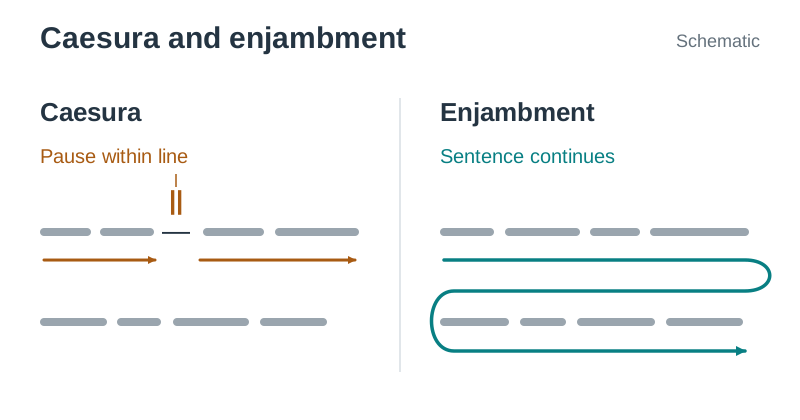
- Caesura: A pause in the middle of a line of verse, usually marked by punctuation such as a comma, full stop, or dash, though it can occur through a natural phrase break. It interrupts the rhythm, forcing the reader to halt or reconsider an idea.
- Enjambment: The continuation of a sentence from one line to the next without a pause or terminal punctuation at the line ending, which accelerates the pace or captures an uninterrupted flow of consciousness.
- Repetition: Reusing words or phrases to reinforce an emotion, mimic a ritual, or reflect obsession.
- Contrast: Juxtaposing opposing images, moods, or settings to heighten their emotional differences.
Structuring Your Answer: The PQE Method
Because you must answer two compulsory 10-mark questions, aim for one to two tightly focused paragraphs per question. Use the Point, Quote, Explain (PQE) structure to keep your analytical voice front and centre.
Answer the Question Asked
Examiners evaluate whether your answer directly addresses the prompt. If the question contains an evaluative term (such as effective, appealing, appropriate, or accurate), use that exact word in your opening sentence. Revisit the word in the concluding sentence of your paragraph to maintain purposeful focus.
Separate Your Points
When a prompt asks you to develop 'two points' or give 'two reasons', signal them clearly using phrases such as 'Firstly' and 'Secondly', or assign each reason its own paragraph. Ensure your two points are genuinely different; claiming that the imagery is vivid and that the descriptions are colourful is merely repeating the same point.
Embed Quotations Smoothly
Avoid copying out full lines or whole stanzas. Weave short quotations of one to four words directly into the grammar of your sentences. Unpack specific words within the quotation to demonstrate how the poet crafts meaning.
Key terms
- Tone
- The attitude adopted by the speaker or poet towards their subject, setting, or audience (e.g. contemplative, defiant, caustic, tender).
- Mood
- The prevailing atmosphere or emotional feeling evoked within the reader by the poem's imagery and language.
- Persona
- The speaker or character voice created by the poet to narrate the poem, who should not automatically be assumed to be the poet themselves.
- Diction
- The poet's deliberate choice and arrangement of vocabulary, ranging from formal and elevated to colloquial and raw.
- Sensory Imagery
- Descriptive language that appeals directly to the physical senses of sight, hearing, touch, smell, or taste.
- Caesura
- A pause near the middle of a poetic line, usually marked by punctuation, which slows the rhythm or isolates a phrase.
- Enjambment
- The continuation of a sentence or syntactic unit across a line break without terminal punctuation, driving the pace forward.
- Volta
- A pronounced turning point or shift in thought, perspective, or emotional tone within a poem.
- Sibilance
- The repeated use of sibilant sounds ('s', 'sh', 'z') to create a whispering, hushed, or threatening auditory effect.
- Extended Metaphor
- A sustained comparison between two unlike things developed across several lines or throughout an entire poem.
- Contrast
- The juxtaposition of opposing ideas, images, or tones to make the qualities of each stand out more vividly.
- Symbol
- A concrete object, animal, or person that represents an abstract concept, value, or emotional state.
Check yourself
In the title 'I felt a Funeral, in my Brain' (prescribed poet Emily Dickinson), what poetic technique is used, and what mood does it establish?
The technique is metaphor. Describing a funeral taking place inside her head suggests psychological torment or mental collapse, establishing an unsettling mood of dread and claustrophobia.
How do tone and mood differ when analysing a poem?
Tone refers to the speaker's or poet's attitude towards the subject (e.g. ironic, affectionate, angry), whereas mood is the prevailing emotional atmosphere experienced by the reader.
What is the functional difference between a caesura and enjambment?
A caesura creates an abrupt pause or break within a line, usually marked by punctuation, while enjambment runs a sentence over a line break without a terminal pause, accelerating the rhythm.
If an exam question asks whether you find a poet's use of language 'appealing', what must your opening sentence contain?
Your opening sentence must state a clear personal judgement using the evaluative word 'appealing' (or explaining that it is partially appealing) before introducing your supporting reasons.