

Literary Genre is not one of the three comparative modes examined on the 2027 paper, but learning its craft is the single most effective way to elevate an answer in the modes that are. It investigates how a narrative is shaped rather than merely what happens. Instead of summarising plot, genre analysis examines the concrete machinery of storytelling across prose, drama, and film. For the 2027 examination cohort, this toolkit supplies the precise authorial evidence needed to show how texts construct a social world in Cultural Context, project a perspective in General Vision and Viewpoint, or develop a central Theme or issue.
The Comparative Section on Paper 2
On Paper 2 the Comparative Study is Section II (the syllabus refers to it as Section B). It is worth 70 marks out of the 200 marks available on Paper 2, alongside the Single Text (60 marks) and Prescribed and Unseen Poetry (70 marks). You should allocate roughly 55 to 60 minutes to this section.
Layout and Question Shapes
Questions are set on two of the three prescribed modes for your examination year. You select one mode and answer it. Within your chosen mode, the paper typically presents two structural options:
- Option 1 — The split question: Part (a) is worth 30 marks and focuses on one text. Part (b) is worth 40 marks and requires a comparison of your other two texts. You must answer both parts.
- Option 2 — The single essay: One continuous essay worth 70 marks, which requires an integrated comparison across your texts.
Timing requires discipline: spend approximately 20 minutes on a 30-mark part (a), 35 minutes on a 40-mark part (b), or the full 55 minutes on a single 70-mark essay. Always reserve two to three minutes at the end to proofread for syntax, spelling, and punctuation, as Mechanics accounts for 10% of your mark under the marking scheme.
The Prescribed Modes for 2027
According to the prescribed material for the Leaving Certificate English examination in 2027, the three Higher Level comparative modes are:
- Theme or issue
- Cultural Context
- General Vision and Viewpoint
Because the State Examinations Commission sets questions on only two of these three modes, you must prepare all three equally. You cannot gamble on studying just two, because you cannot predict which mode will be omitted. Fortunately, your core textual evidence and genre techniques remain identical across all three modes; only your critical argument changes.
Rules for Text Selection and Text Counts
Examiners enforce strict regulations regarding text numbers and selection:
- The no-reuse rule: The text you select for your Single Text question on Paper 2 cannot be used in your comparative answer. If you study Hamnet on its own, it cannot form part of your comparative trio, even though it appears on the comparative reading list.
- The Shakespeare rule: At Higher Level, studying a play by William Shakespeare is compulsory. It can be taken as your Single Text or inside your comparative group. For the 2027 exam, Othello is listed for both single-text study and comparative study, whereas Macbeth is prescribed only on the comparative list. If Macbeth is your Shakespearean text, it must be studied as one of your three comparative texts.
- The film regulation: You may include at most one official film in your comparative study. Your other two comparative works, along with your single text, must be written texts, guaranteeing at least three written texts overall.
- Obey the text count: Underline the exact number of texts demanded in the prompt. If a question asks for "one text", writing on a second text wastes time and earns zero credit. If it specifies "at least two texts", you can write on two or three, but each must be analysed in depth. If it demands "three texts", all three must be woven through the essay, not tacked on at the end.
Medium-Specific Conventions: Prose, Drama, and Film
The Leaving Certificate syllabus requires candidates to adopt appropriate critical stances for reading and viewing across genres. A stage play must be evaluated as a live theatrical event, a film as an audio-visual composition, and a novel or memoir as an exploration of language and interiority.
The Novel and Memoir (Narrative Voice and Interiority)
Prose fiction allows direct access to a character's interior thoughts and perceptions:
- Narrative voice: First-person narration creates intimacy and emotional proximity, but it can introduce bias. An unreliable narrator forces the reader to interrogate assertions due to the character's naivety, prejudice, or self-deception. Third-person limited narration restricts the perspective to the perceptions of a single protagonist, while third-person omniscient narration ranges freely across multiple characters and settings.
- Graphic memoir: Works such as Thi Bui's The Best We Could Do combine prose text with visual panels. Meaning is created not just by words, but by panel borders, shading, framing, and the gutter space between panels. When citing a graphic memoir in an essay, describe the visual panel precisely, just as you would describe a film shot.
What evidence looks like in an answer: For prose fiction, your primary evidence is a short, verbatim quotation woven directly into your sentence syntax.
Drama (Theatrical Space and Action)
Plays are composed for live acoustic and physical spaces. A dramatist cannot directly explain internal thoughts; inner conflict must be externalised:
- Dialogue and subtext: Tension frequently lives in subtext—the underlying meaning, hostility, or anxiety lurking beneath polite or evasive speech.
- Soliloquy and aside: A soliloquy allows a character alone on stage to speak private thoughts directly to the audience, revealing true motivations. An aside is a brief comment spoken under the breath or directed to the audience, conventionally unheard by other figures on stage.
- Staging and stagecraft: Playwrights use stage directions to dictate blocking (actor movement and spatial positioning), lighting states, costuming, and props. A single set choice, such as Henrik Ibsen's locked letterbox in A Doll's House, visually manifests domestic surveillance and control.
What evidence looks like in an answer: For drama, your evidence consists of a quoted line accompanied by the specific stage direction, blocking, or physical action surrounding it.
Film (Cinematic Language and Editing)
In film, the camera functions as the narrator. Every choice of lens, camera height, cut, and sound cue conveys dramatic meaning:
| Cinematic Element | Narrative Function | Example Impact |
|---|---|---|
| Camera Angles | Establishes status, vulnerability, or authority. | High angles look down on a character to suggest helplessness; low angles create intimidation and dominance. |
| Framing & Shots | Controls psychological intimacy and context. | A close-up exposes micro-expressions; a wide shot isolates individuals within an imposing environment. |
| Lighting & Colour | Establishes mood, atmosphere, and moral tone. | Low-key, shadowy lighting creates moral ambiguity; warm palettes evoke nostalgia or safety. |
| Sound Design | Directs emotional tension and narrative focus. | Diegetic sound belongs inside the story world (dialogue, footsteps); non-diegetic sound is added for the viewer (orchestral score, voice-over). |
| Montage & Editing | Controls narrative pacing and reveals connections. | Rapid cross-cutting accelerates narrative speed to highlight simultaneous danger or build tension. |
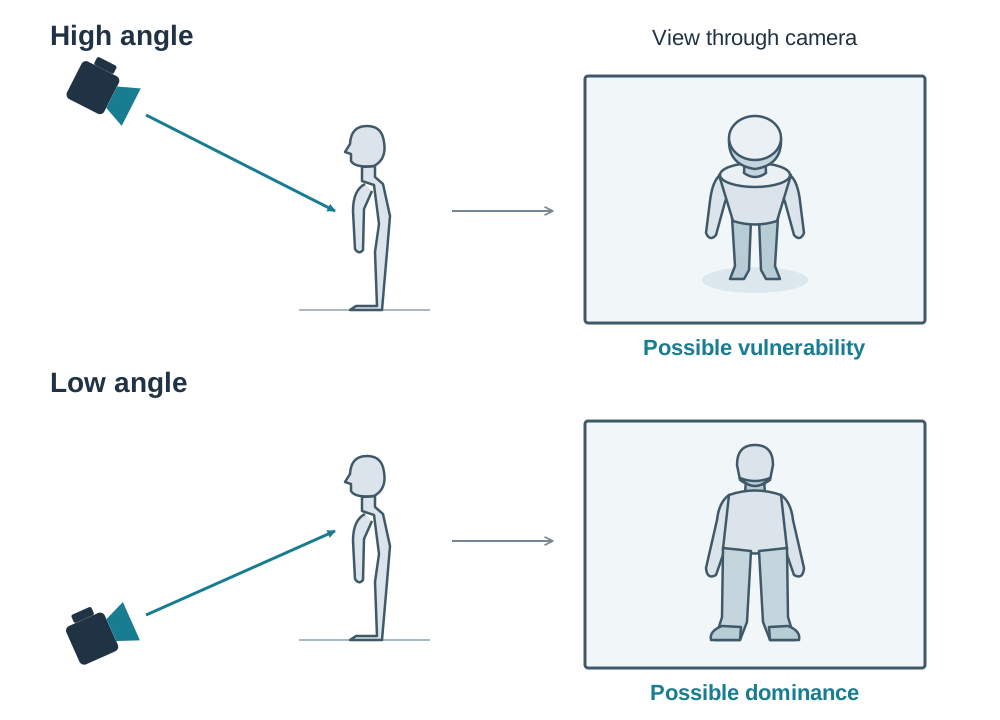
What evidence looks like in an answer: For film, you do not need long dialogue quotations; a precisely described camera shot, cut, or sound cue counts fully as evidence.
Structural Architecture and Key Moments
Structure is the deliberate sequencing of scenes to regulate suspense, curiosity, and emotional impact. The same event—a betrayal, say—can happen in a novel, a play or a film, but it lands on us very differently depending on whether we are told it in prose, watch it acted on stage, or see it framed by a camera.
Timeline and Audience Knowledge
- Chronological vs non-linear structure: A chronological narrative advances sequentially, building cause-and-effect momentum toward a crisis. Non-linear structures introduce flashbacks to interrupt the present, providing critical back-story at the moment of peak psychological resonance.
- Foreshadowing and suspense: Suspense keeps the audience in anxious anticipation of what will occur next, while foreshadowing plants subtle clues and motifs that hint at the eventual outcome.
- Dramatic irony: Occurs when the audience knows something important that a character on stage or screen does not, so we watch ordinary lines with a sense of dread.
- The Climax: The decisive turning point and highest point of tension in a narrative, where the central conflict finally comes to a head. What follows it—the working-out of consequences—is the resolution or dénouement. In drama, climaxes are produced by stage confrontations; in film, by rapid montage and soaring scores; in prose, by compressed syntax and psychological crisis.
Building a Bank of Key Moments
You cannot analyse technique in the abstract; you need a fixed set of narrative anchors. For each of your comparative texts, master four or five key moments:
- The opening scene or chapter
- A moment of crisis or sudden disruption
- The climax
- A major turning point in a relationship
- The resolution or final image
For each moment, memorise what happens in one concise sentence, the specific technique the creator uses, and one short quotation or cinematic description. The same key moment can serve multiple modes: Nora's confrontation in A Doll's House provides evidence for Cultural Context (bourgeois gender roles), General Vision and Viewpoint (an unsettling ending), and Theme or issue (truth versus illusion).
The Four-Step Method and Comparative Linking
Retelling the story earns almost nothing, and so does naming a technique and moving on. Marks come from explaining what the technique does to the reader or viewer. High-scoring essays use a disciplined four-step method:
- Name: Identify the specific technique using accurate terminology (e.g. third-person limited narration, low-angle shot, non-diegetic score).
- Place: Anchor the technique to an exact, identifiable textual moment.
- Explain effect: Explain how this choice shapes audience empathy, tension, or understanding.
- Judge effectiveness: Evaluate how successfully the technique achieves the author's or director's dramatic purpose.
Contrasting Weak and Strong Analysis
Prose Example: Claire Keegan's Small Things Like These
- Weak (Descriptive): Claire Keegan uses flashbacks in Small Things Like These. Furlong remembers his childhood and Mrs Wilson.
- Strong (Analytical): Keegan's flashbacks to Furlong's childhood, as the son of an unmarried mother sheltered by Mrs Wilson, are placed at points where his conscience is troubled in the present. This non-linear structure demonstrates that his unease regarding the convent is rooted in personal gratitude and empathy. His childhood memories explain his psychological vulnerability, making his final moral defiance feel earned rather than abrupt.
Film Example: Frank Darabont's The Shawshank Redemption
- Weak (Descriptive): Darabont uses close-up shots to show Andy's feelings when he plays the Mozart record.
- Strong (Analytical): When Andy locks himself in the warden's office, Darabont tracks slowly into an extreme close-up of Andy's serene expression before cutting to a high-angle extreme long shot of the entire prison yard frozen in place. By flooding this visual composition with the diegetic Mozart duet Andy broadcasts over the prison public-address system, Darabont captures the transcendent, liberating power of art within a brutalising institution.
Comparative Language Stems
Examiners reward sustained, woven comparisons over separate text summaries. Use these comparative stems to connect your texts across paragraphs:
- Where [Author A] relies on [Technique] to expose..., [Director B] instead uses [Technique] to visualise...
- A similar sense of entrapment is achieved through different means in [Text B], where...
- In marked contrast to the acoustic silence of [Text A], [Text B] escalates tension through...
- While [Character A]'s internal crisis is revealed via narrative voice, [Character B]'s isolation is externalised through stage blocking.
Deploying Genre Craft Inside 2027 Prescribed Modes
Because Literary Genre is rotated off the active paper for 2027, you must never write an essay that merely catalogues techniques. Every paragraph must begin and end with the prescribed mode named in the exam prompt. Use this sentence structure: technique + moment + effect on audience + therefore what this reveals about the mode.
General Vision and Viewpoint
Do not merely state whether a text is optimistic or pessimistic; show how narrative craft creates that outlook. In Frank Darabont's The Shawshank Redemption, Red's retrospective voice-over frames the whole story like a spoken memoir, filtering Andy's actions through personal reflection. After two hours of cramped, grey cellblocks, the final wide shot of the sunlit Pacific visualises the triumph of human hope.
Cultural Context
Demonstrate how staging, framing, and narrative style reveal the power structures, religious controls, and gender expectations of a society. In Henrik Ibsen's A Doll's House, the single domestic interior, the locked letterbox, and Nora's frantic tarantella dance physically embody the claustrophobic social surveillance of nineteenth-century bourgeois marriage.
Theme or Issue
Trace how recurring motifs, symbols, and structural crises explore a central concept. In Claire Keegan's Small Things Like These, the persistent motifs of coal dust, pervasive frost, and domestic routine reflect the moral numbness and communal complicity that allow institutional abuse to persist.
Key terms
- Narrative Voice
- The perspective through which a story is told, dictating how events and characters are filtered, interpreted, and presented to the reader.
- Unreliable Narrator
- A narrator whose credibility or objectivity is compromised by bias, naivety, youth, psychological distress, or deliberate dishonesty.
- Subtext
- The unspoken thoughts, emotional undercurrents, and tensions concealed beneath the spoken dialogue or overt actions of characters.
- Soliloquy
- A dramatic convention where an actor, alone on stage, speaks private thoughts aloud, allowing the audience direct access to the character's internal dilemmas.
- Aside
- A short remark spoken by an actor that is conventionally audible to the audience but unheard by other characters present on the stage.
- Stage Directions
- A playwright's written instructions detailing blocking, physical movement, set design, props, sound effects, and lighting.
- Blocking
- The precise spatial arrangement and physical movement of actors on a stage or across a camera frame.
- Dramatic Irony
- A narrative device where the audience knows something important that a character on stage or screen does not, so that ordinary dialogue generates tension or foreboding.
- Foreshadowing
- An authorial device that introduces subtle hints, motifs, or symbolic warnings early in a text to prepare the audience for future events.
- Motif
- A recurring image, phrase, sound, or object that appears across a narrative to develop and reinforce a central theme.
- Juxtaposition
- Placing contrasting characters, scenes, settings, or visual elements close together to highlight differences and generate meaning.
- Pathetic Fallacy
- A literary device that attributes human emotions, moods, or internal conflicts to nature, physical landscapes, and weather.
- Diegetic Sound
- Sound that originates within the fictional world of a film or play and can be heard by the characters (e.g. dialogue, gunshots, footsteps).
- Non-Diegetic Sound
- Sound added outside the narrative world for the audience's benefit, such as musical underscoring, mood audio, or detached voice-over commentary.
- Montage
- A film editing technique that rapidly splices together a series of short shots to condense narrative time, establish connections, or accelerate tension.
- Climax
- The decisive turning point and highest point of tension in a narrative, where the central conflict finally comes to a head. What follows it—the working-out of consequences—is the resolution or dénouement.
- Theme or issue
- A prescribed comparative mode that investigates a central idea, human question, or moral concern explored across multiple texts.
- Cultural Context
- A prescribed comparative mode that analyses the social, economic, religious, and political world in which a text's characters live and struggle.
- General Vision and Viewpoint
- A prescribed comparative mode that assesses the overall outlook or stance of a text—whether essentially optimistic, pessimistic, cynical, or redemptive.
Check yourself
How are Paper 2 essay answers marked under the SEC criteria?
They are assessed using the PCLM criteria: Clarity of Purpose (30%), Coherence of Delivery (30%), Efficiency of Language Use (30%), and Accuracy of Mechanics (10%).
Can you choose William Shakespeare's Macbeth as your single text on Paper 2 in 2027?
No. In the prescribed material for 2027, Macbeth appears only on the comparative list; Othello appears on both lists. If you study Macbeth, it must be included in your comparative study.
What is the structural difference between a narrative climax and its resolution?
The climax is the highest point of dramatic tension and the decisive turning point where core conflicts collide; the resolution (or dénouement) follows it, working out the aftermath and consequences.
Rewrite this weak statement into an analytical sentence using film terminology: 'Darabont uses camera angles to show Andy is helpless when he arrives at prison.'
As Andy arrives at Shawshank, Darabont uses an extreme high-angle shot looking down from the stone walls to make him appear physically dwarfed and vulnerable against the imposing prison architecture.
A student writes a paragraph on the locked letterbox in A Doll's House for Cultural Context. How should the final sentence conclude to maintain the mode?
It must tie the prop back to the social world: 'Because Torvald alone retains the key to the letterbox, this stage prop visualises the complete economic and social subordination of women within nineteenth-century bourgeois marriage.'
Why should you prepare all three prescribed comparative modes for 2027 rather than just two?
The examination paper presents questions on only two of the three prescribed modes, and which two appear is unknown in advance. Preparing only two risks having only one question option or being left with an unsuitable question.