

Emily Brontë's 1847 novel Wuthering Heights is prescribed for the Leaving Certificate Higher Level English examination in 2027 exclusively as a comparative text under the Novel/Memoir category. It cannot be studied as a single text for Section I. In Paper 2, Section II, candidates examine the text alongside two other works through one of the three prescribed comparative modes for 2027: Theme or issue, Cultural Context, or General Vision and Viewpoint. The narrative spans two generations across the Yorkshire moors, contrasting the raw isolation of Wuthering Heights with the refined gentility of Thrushcross Grange to explore how social hierarchy, racial prejudice, domestic tyranny, and vengeful obsession tear families apart until a second generation achieves a hard-won, qualified reconciliation.
Curricular Rules and Section II Exam Mechanics
Under the prescribed material for the 2027 examination, Wuthering Heights appears only on the comparative list (Novel/Memoir) and so may be answered on only in Section II. It cannot be studied as your Single Text in Section I.
The Shakespeare Requirement and Text Selection
At Higher Level, studying a play by William Shakespeare is compulsory. You must study Shakespeare either as your Single Text in Section I or as one of your three texts in the comparative study in Section II. Two strict rules govern your text choices:
- You cannot reuse your single text in the comparative study. Titles such as Othello, Hamnet, and The Great Gatsby appear on both lists, but whichever text you choose for Section I is strictly off-limits in Section II.
- One of your three comparative texts may be a film, but only if it is explicitly listed on the prescribed film list for 2027 (such as The Banshees of Inisherin, Knives Out, or The Third Man). A film adaptation of a novel or play does not count as a separate text.
Exam Timing and Marks
Paper 2 lasts 3 hours and 20 minutes and carries 200 marks: Section I (Single Text) is worth 60 marks, Section II (Comparative Study) is worth 70 marks, and Section III (Poetry) is worth 70 marks. You should allocate roughly 70 minutes to your comparative essay.
Three comparative modes are prescribed for Higher Level in 2027:
- Theme or issue
- Cultural Context
- General Vision and Viewpoint
The State Examinations Commission (SEC) sets questions on only two of these three modes on the exam paper, and you answer on one. You will not know which two will appear until you open the paper. You must prepare at least two modes thoroughly, and ideally know the third in outline. Whichever question you select, name the mode in your opening sentence and keep linking back to it throughout.
Plot Architecture and Two-Generation Structure
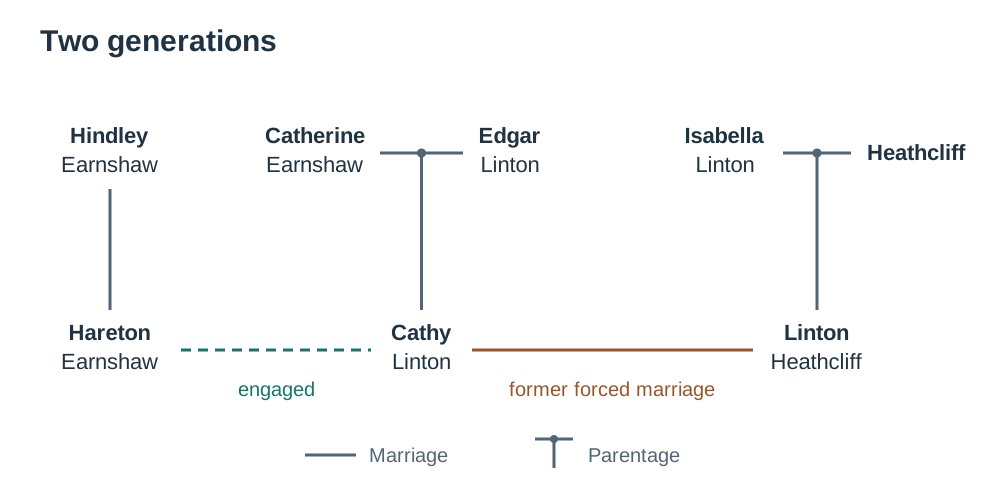
Brontë structures the novel across two distinct generations. The first generation traces disruption, cruelty, and self-destruction; the second generation repeats these traumas before dismantling them through literacy and empathy.
The First Generation: Disruption and Destruction
Mr Earnshaw brings home a destitute, dark-skinned foundling from Liverpool and names him Heathcliff. Earnshaw favours him over his biological son Hindley, sparking bitter sibling jealousy. When Hindley inherits Wuthering Heights, he degrades Heathcliff to an uneducated farmhand. Despite this abuse, Heathcliff forms a passionate, spiritual affinity with Hindley's sister, Catherine Earnshaw.
After five weeks convalescing at Thrushcross Grange, Catherine returns transformed by the manners and luxury of the landed gentry. She accepts a proposal from Edgar Linton. Confiding in Nelly Dean, Catherine admits that it would degrade her to marry Heathcliff, not knowing that Heathcliff is listening in the next room. He hears that much and no more: he slips out into the storm before she can say that her soul and his are identical, and that she loves him as the eternal rocks beneath. Heathcliff vanishes for three years, returning as a wealthy gentleman driven by calculated revenge. He exploits Hindley's gambling habits to claim ownership of the Heights, traps Edgar's naive sister Isabella into an abusive marriage, and precipitates Catherine's mental and physical breakdown. Catherine dies giving birth to her daughter, Cathy.
The Second Generation: Repetition and Redemption
Heathcliff extends his campaign of revenge to the next generation: Hindley's son Hareton, his own sickly son Linton Heathcliff, and Catherine's daughter Cathy Linton. He degrades Hareton into illiteracy and forces young Cathy to marry Linton. Edgar dies first, with Cathy already married to Linton; Linton then dies, having signed over to his father everything that came to him through his wife. In this way Heathcliff ends up holding both the Heights and the Grange, and young Cathy, the Grange's rightful heiress, is left an impoverished dependant in her enemy's house.
Brontë halts this cycle before it destroys the family line completely. Following Linton's death, Cathy befriends Hareton and teaches him to read, replacing hostility with mutual respect. In his last days Heathcliff tells Nelly that Catherine is constantly near him, and he refuses food and sleep. Brontë never confirms whether this is a genuine visitation or a mind collapsing under obsession, and Nelly, our only witness, is unsure herself. Either way, his appetite for revenge drains away before he dies in the old panelled bed. The novel ends with Cathy and Hareton engaged to marry and preparing to move to Thrushcross Grange, while Wuthering Heights itself is to be closed up. The hope is real but partial: gentleness and literacy win, yet the house where the damage was done is abandoned rather than healed.
Character Reference and Comparative Functions
Under exam pressure, take care never to confuse Catherine Earnshaw (the mother) with Cathy Linton (the daughter), or Edgar Linton (the master of the Grange) with Linton Heathcliff (Heathcliff and Isabella's sickly son).
| Character | Social Role and Relationships | Comparative and Thematic Function |
|---|---|---|
| Heathcliff | Foundling brought to the Heights; later master of both properties. | Acts as both abused victim and ruthless persecutor, demonstrating the self-consuming futility of revenge and the isolation of the racial outsider. Embodies the Byronic hero. |
| Catherine Earnshaw | Hindley's sister; marries Edgar Linton; mother of Cathy. | Driven by divided desires; her choice of social standing over emotional truth demonstrates how class and marriage customs constrain personal freedom. |
| Edgar Linton | Master of Thrushcross Grange; Catherine's husband. | Represents refined gentility, legalism, and domestic affection; functions as a cultural foil to Heathcliff rather than a simple villain. |
| Hindley Earnshaw | Catherine's brother; master of the Heights; father of Hareton. | Instigates the cycle of violence by brutalising Heathcliff, illustrating how inherited class pride and domestic cruelty breed retaliation. |
| Isabella Linton | Edgar's sister; elopes with Heathcliff; mother of Linton. | Exposes romantic delusion and demonstrates how the legal rule of coverture left married women vulnerable to unchecked domestic abuse. |
| Cathy Linton | Daughter of Catherine and Edgar; forced wife of Linton; betrothed to Hareton. | Represents resilience and active repair; she halts inherited trauma through patience, affection, and education. |
| Hareton Earnshaw | Hindley's son; raised in deliberate ignorance by Heathcliff. | Shows that innate decency can survive deprivation when nurtured by kindness and literacy. |
| Linton Heathcliff | Son of Heathcliff and Isabella; married to Cathy. | A petulant, ailing pawn used by Heathcliff as an instrument of legal and financial extortion. |
| Nelly Dean | Housekeeper and primary internal narrator. | Speaks for conventional, respectable morality and practical common sense, but she is a participant as well as a witness; her loyalties and prejudices colour everything she tells Lockwood. |
| Mr Lockwood | Tenant at Thrushcross Grange; outer frame narrator. | An outsider whose conventional assumptions highlight the insularity and raw violence of the moorland society. |
Mode 1: Cultural Context
Cultural Context examines how the world of the text shapes the decisions, values, and fates of its characters. In an exam answer, focus on the specific social rules, prejudices, and power dynamics inside the world Brontë creates.
Class Hierarchy and Social Ambition
Late eighteenth-century Yorkshire is divided along strict economic lines. Thrushcross Grange represents the landed gentry, defined by fine linen, books, manners, and legal propriety. Wuthering Heights represents an older, rugged agrarian order. Catherine recognises that her instinctive bond with Heathcliff cannot survive the economic realities of her world: she tells Nelly, "It would degrade me to marry Heathcliff now". Her choice to marry Edgar Linton is an act of social self-preservation required by her culture.
Race and Origin
Heathcliff arrives at the Heights with no name, no family, and no known origin. Characters repeatedly apply foreign labels to him, calling him a "gypsy", a "castaway", and speculating that his father was an Emperor of China and his mother an Indian queen. Nelly even invents a noble foreign lineage to comfort him. The community rejects him not only because he lacks land and pedigree, but because he does not look or sound like one of them. His exclusion is built on a mixture of class and racial prejudice, which explains why acquiring wealth alone never makes him socially acceptable at Thrushcross Grange: in Brontë's world, respectability is inherited rather than bought.
Patriarchy, Property, and Coverture
Under the legal doctrine of coverture, a woman's legal identity and property were absorbed into those of her husband upon marriage. Isabella Linton discovers this when she elopes with Heathcliff: she loses legal standing, control of her wealth, and protection from domestic violence. Heathcliff later forces young Cathy into marriage with his dying son Linton so that, under inheritance laws, Edgar Linton's estate passes through Linton directly into Heathcliff's hands.
Education and Literacy as Instruments of Power
Literacy functions as an instrument of control. Hindley degrades Heathcliff by halting his schooling and reducing him to field work. Heathcliff exacts identical revenge on Hindley's son Hareton, taking pride in keeping him illiterate. When Cathy patiently teaches Hareton to read, literacy shifts from a tool of subjugation into an instrument of mutual respect and social recovery.
Religion and Moral Rigidity
Formal religion is personified by Joseph, whose harsh, hypocritical Calvinism uses scripture to condemn everyone around him while showing no real charity to anyone. Brontë depicts rigid orthodoxy as cold and punitive, setting it against Catherine and Heathcliff's wild, pantheistic attachment to the moors.
Mode 2: Theme or Issue
When comparing themes, define the issue precisely: examine the difference between destructive obsession and companionate love, or explore revenge and its personal cost to the avenger.
Revenge and Retribution
Revenge is Heathcliff's organising motive across decades. Instead of relying merely on physical violence, he co-opts the legal and financial mechanisms of the gentry: mortgages, forced marriages, and debt. Yet Brontë reveals that revenge hollows out the avenger. Once both properties are firmly under his control, Heathcliff admits to Nelly, "I have lost the faculty of enjoying their destruction". His victory leaves him exhausted and alienated from human contact, proving that systematic retribution destroys the persecutor from within.
Destructive Obsession versus Companionate Love
Brontë establishes a stark contrast between two kinds of attachment:
- The Elemental Bond: Catherine and Heathcliff share an identity-fusing, all-consuming passion. Catherine declares, "I am Heathcliff", and contrasts her feelings: "My love for Linton is like the foliage in the woods... my love for Heathcliff resembles the eternal rocks beneath". Because their bond rejects domestic reality and social compromise, it breeds jealousy, torment, and death. After her passing, Heathcliff cries, "I cannot live without my life! I cannot live without my soul!"
- The Companionate Bond: In contrast, young Cathy and Hareton build a relationship founded on patience, shared books, and mutual respect. Brontë shows that while elemental obsession consumes the self, companionate love offers emotional endurance and practical healing.
Cyclical Trauma and Generational Healing
Hindley's early abuse of Heathcliff sparks decades of reciprocal violence. Once in power, Heathcliff replicates Hindley's cruelty upon Hareton. However, the novel refuses simple fatalism. Through Cathy's empathy and Hareton's willingness to learn, the younger generation breaks the inherited pattern of domestic cruelty.
Mode 3: General Vision and Viewpoint
General Vision and Viewpoint concerns the author's overarching outlook on human existence: whether life is depicted as a hopeless, fatalistic struggle or as an experience capable of renewal and redemption. In Wuthering Heights, trace a distinct movement rather than a static mood.
The Opening Outlook: Claustrophobic Hostility
Lockwood's arrival in 1801 establishes an atmosphere of intense hostility: barred doors, chained dogs, domestic contempt, and Heathcliff's ferocious anti-social temper. When Lockwood stays in the panelled bed he dreams of a weeping child at the window begging to be let in; terrified, he rubs her wrist against the broken pane until it bleeds. Even the polite outsider turns cruel here, and the opening presents a claustrophobic world trapped in unhealed grief and emotional isolation.
The Middle Movement: Oppressive Suffering
Nelly's spoken history reveals years of domestic cruelty, forced marriage, emotional breakdown, and early death. Adults systematically inflict their unresolved anger onto children. Catherine dies in torment, Isabella flees an abusive home, and Heathcliff imprisons young Cathy at the Heights. For most of the narrative, the text's vision feels relentless and grim.
The Closing Movement: Qualified Hope
The final chapters execute a decisive shift. Heathcliff's vengeful energy fades as his obsession with Catherine consumes him, clearing the space for Cathy and Hareton to reconcile. When Lockwood returns in 1802, he finds open doors, windows looking onto a sweet garden, and Cathy helping Hareton read. Heathcliff dies in the panelled bed, and Cathy and Hareton prepare to move away to Thrushcross Grange. Lockwood's closing reflection at the three headstones sets the final tone: "I wondered how any one could ever imagine unquiet slumbers for the sleepers in that quiet earth". Brontë offers qualified hope: healing and gentleness survive, but only after decades of damage that cannot be undone.
Narrative Perspective and Mode Evidence
Brontë employs a complex frame narrative that must not be treated as a transparent account of events. Lockwood transcribes the history in his diary, but almost all the domestic detail comes from Nelly Dean, an internal narrator with her own class loyalties, jealousies, and moral blind spots.
Turning Unreliable Narration into Mode Evidence
- For Cultural Context: Because everything is filtered through Nelly's conventional, churchgoing viewpoint, Catherine and Heathcliff's behaviour is continually evaluated by the very social codes that destroy them. When Nelly scolds Catherine for her wild nature or withholds crucial messages, her narrative acts as a direct demonstration of how respectable society polices and punishes emotional non-conformity.
- For General Vision and Viewpoint: Lockwood's perspective shifts from urban cynicism and fear in the opening chapters to quiet acceptance during his 1802 visit. Watching his superficial assumptions collapse against the reality of the moors reinforces the idea that understanding human suffering requires empathy rather than detached judgement.
Key Moments and Core Quotation Bank
Every Section II answer requires support from close reference or direct quotation. Commit these key moments and exact lines to memory.
Key Moments Across the Modes
- Lockwood's night in the panelled bed and the child-ghost: Establishes the opening vision of violent grief, isolation, and spectral unrest. (General Vision and Viewpoint)
- Catherine's five weeks at Thrushcross Grange: The cultural turning point where class division and material luxury sever Catherine from Heathcliff. (Cultural Context)
- Catherine's confession to Nelly and Heathcliff's flight: The hinge of the entire plot, where social status overtakes private identity. (All three modes)
- Heathcliff's return as a gentleman and seizure of the Heights: Class vengeance executed through legal mortgages and debt. (Theme: revenge; Cultural Context: class and money)
- Isabella's elopement and escape: Shows the brutal reality of domestic violence and women's lack of legal protection under coverture. (Cultural Context)
- Catherine's death after giving birth to Cathy: Highlights the fatal consequences of emotional fragmentation and social compromise. (Theme; General Vision and Viewpoint)
- Cathy's imprisonment and forced marriage to Linton: Shows domestic tyranny operating on the moors beyond the reach of the law. (Cultural Context)
- Heathcliff admits his loss of vengeful desire: The avenger acknowledges that retribution brings no satisfaction. (Theme: revenge)
- Cathy teaching Hareton to read: Literacy transforms from a tool of subjugation into an instrument of redemption. (Theme: healing; General Vision and Viewpoint: turn towards hope)
- Heathcliff's death in the panelled bed: The physical end of the cycle of vengeance. (General Vision and Viewpoint)
- Lockwood's visit to the three graves: The closing vision of qualified peace under an open sky. (General Vision and Viewpoint)
Quotation Bank
- Catherine on class: "It would degrade me to marry Heathcliff now".
- Catherine on their spiritual identity: "whatever our souls are made of, his and mine are the same".
- Catherine on the nature of her love: "I am Heathcliff — he's always, always in my mind".
- Catherine contrasting Edgar and Heathcliff: "My love for Linton is like the foliage in the woods… my love for Heathcliff resembles the eternal rocks beneath".
- Heathcliff's grief: "I cannot live without my life! I cannot live without my soul!".
- Heathcliff on revenge: "I have lost the faculty of enjoying their destruction".
- Lockwood's closing reflection: "I wondered how any one could ever imagine unquiet slumbers for the sleepers in that quiet earth".
Structuring Comparative Responses
Comparative answers in Paper 2, Section II are marked under four criteria:
- Clarity of Purpose (30%): Directly answering the prompt, sustaining a clear comparative thesis, and naming the mode using official syllabus wording.
- Coherence of Delivery (30%): Developing arguments logically, using smooth comparative links, and organising ideas into well-structured paragraphs.
- Efficiency of Language Use (30%): Writing in an analytical, controlled style with varied sentence structures and accurate vocabulary.
- Accuracy of Mechanics (10%): Maintaining sound grammar, punctuation, and spelling.
Essay Formats: 70-Mark Single Essay vs 30/40-Mark Split Questions
Each mode on the exam paper usually offers a choice between:
- A Single 70-Mark Question: You compare all three texts (or two texts, if explicitly directed by the paper). Never write three separate text summaries. Structure each body paragraph around one aspect of the mode, moving between texts within every paragraph using direct comparative links.
- A Divided Question (typically 30 marks and 40 marks): The marks are printed beside each part; read them and the wording carefully. Part (a) normally examines one text on its own; part (b) asks for comparison, but whether it requires your other two texts or allows you to return to text one depends on the phrasing on the paper.
Using Comparative Sentences
Rather than relying on isolated linking words, build full sentences that compare how different authors handle the same element of the mode:
- Whereas Brontë allows the second generation to rebuild what the first destroyed, Fitzgerald leaves Gatsby's dream to be cleared away with his belongings.
- In marked contrast to Heathcliff's racial and social exclusion on the Yorkshire moors, the characters in my second text operate within an urban community where class boundaries are maintained by institutional authority.
Comparative Revision Grid
Use this grid to prepare your comparative material across your three texts. Fill in one key moment and one embedded quotation for each cell.
| Mode Aspect | Wuthering Heights | Comparative Text 2 | Comparative Text 3 |
|---|---|---|---|
| Class and Money | Catherine admits marrying Heathcliff would "degrade" her; chooses Edgar's wealth at the Grange. | ||
| Race and the Outsider | Heathcliff branded a "gypsy" and castaway; foreign appearance permanently bars social acceptance. | ||
| Gender and Marriage | Isabella loses legal rights and property under coverture after eloping with Heathcliff. | ||
| Education and Power | Heathcliff brutalises Hareton through enforced illiteracy; Cathy restores him by teaching him to read. | ||
| Law and Violence | Isolation of the moors shields Heathcliff's forced imprisonment of Cathy from civil oversight. | ||
| Closing Vision | Lockwood reflects on the "sleepers in that quiet earth"; qualified hope as Cathy and Hareton unite. |
Key terms
- Cultural Context
- The prescribed Higher Level comparative mode that evaluates how societal values, class hierarchies, gender conventions, legal frameworks, and religious codes govern character decisions.
- General Vision and Viewpoint
- The prescribed Higher Level comparative mode evaluating the author's overarching philosophical stance on life, tracing whether the outlook is fundamentally bleak, fatalistic, or moving towards hope and renewal.
- Theme or issue
- The prescribed Higher Level comparative mode exploring a specific human dilemma or philosophical idea across multiple literary works.
- Byronic hero
- A brooding, fiercely passionate, intelligent character haunted by past trauma and driven by rebellious, destructive tendencies, as personified by Heathcliff.
- Coverture
- The historical legal doctrine where a woman's legal, property, and economic rights were subsumed into those of her husband upon marriage, exploited by Heathcliff against Isabella and Cathy.
- Foil
- A character or setting that illuminates the qualities of another through sharp contrast, such as Edgar Linton contrasting with Heathcliff, or Thrushcross Grange contrasting with Wuthering Heights.
- Qualified hope
- An authorial outlook that presents authentic reconciliation and future promise while fully acknowledging that past trauma and loss cannot be undone.
- Frame narrative
- A nested structural device where an outer story provides the context for an inner account, seen here as Lockwood's journal frames Nelly Dean's spoken history.
- Clarity of Purpose
- The SEC marking criterion (30%) evaluating how directly and consistently the response answers the specific prompt asked and sustains a comparative thesis.
- Coherence of Delivery
- The SEC marking criterion (30%) evaluating structural organisation, logical flow, paragraph development, and seamless linking across texts.
- Efficiency of Language Use
- The SEC marking criterion (30%) assessing critical register, vocabulary precision, sentence control, and analytical style.
- Accuracy of Mechanics
- The SEC marking criterion (10%) evaluating adherence to correct spelling, grammar, punctuation, and syntax.
Check yourself
Can Wuthering Heights be selected as a Single Text (Section I) in the 2027 Leaving Certificate examination?
No. Under the official 2027 prescribed list, Wuthering Heights is approved strictly as a comparative novel for Paper 2 Section II.
What are the three comparative modes prescribed for Leaving Certificate Higher Level in 2027, and how many appear on the paper?
The three prescribed modes are Theme or issue, Cultural Context, and General Vision and Viewpoint. Exactly two of these three will appear on the examination paper, and candidates answer on one.
Name two key moments you would use to show that the general vision of Wuthering Heights shifts across the novel, and state what each reveals.
First, Lockwood's night in the panelled bed with the child-ghost scraping at the window, which establishes an opening vision of claustrophobic hostility and unhealed trauma. Second, Cathy teaching Hareton to read in the open, sunlit room, which demonstrates the shift towards qualified hope and generational healing.
Why is young Cathy teaching Hareton to read significant in terms of theme and vision?
Education was previously weaponised by Hindley and Heathcliff to enforce subjugation. Cathy's reading lessons replace cruelty with mutual respect, breaking the cycle of trauma and turning the general vision towards qualified hope.
What legal doctrine allows Heathcliff to seize ownership of Thrushcross Grange through Isabella and young Cathy?
The doctrine of coverture, under which a married woman's legal rights and property were completely subsumed into those of her husband.