

In Leaving Certificate Higher Level English Paper 1 (English I), Section I examines your comprehending skills through unseen texts. The examination booklet provides three texts linked by a general theme. You must answer Question A (50 marks) on one text and Question B (50 marks) on a completely different text. Question A tests how writers shape meaning through the syllabus's five functions of language. Doing well here means drawing out sharp insights, putting concepts into your own words, analysing specific stylistic craft, stating an explicit critical stance, and embedding brief, exact quotations into your sentences.
How Section I Comprehending Works
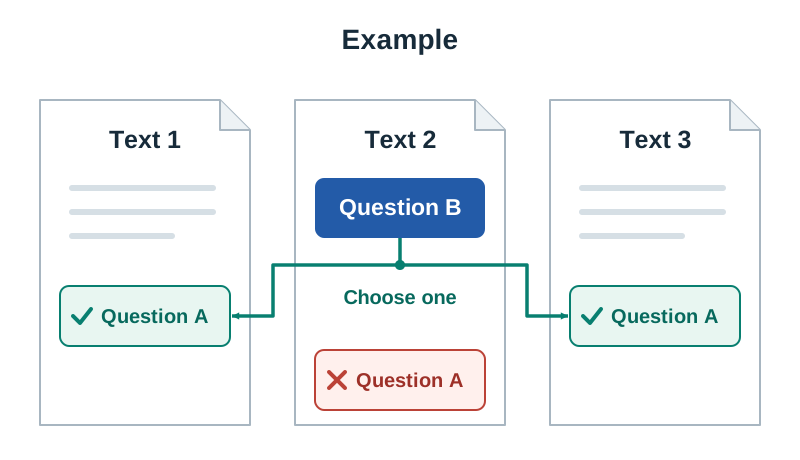
Section I tests how clearly you read, interpret, and evaluate unseen texts. The exam paper gives you three texts: Text 1, Text 2, and Text 3. The golden rule of Section I is simple but vital: you must answer Question A on one text and Question B on a completely different text. If you answer Question A and Question B on the exact same text, you run the risk of losing the marks for one of those 50-mark answers entirely. Read through the paper and make your choices before putting pen to paper.
Your work across Leaving Certificate English is marked using four assessment criteria known as the PCLM system:
- Clarity of Purpose (P): Directly answering the question asked, keeping your focus tight, and showing a solid grasp of the chosen genre.
- Coherence of Delivery (C): Structuring your ideas logically with clean paragraph breaks, sensible progression, and linking phrases.
- Efficiency of Language Use (L): Writing with precision, vocabulary control, varied sentence shapes, and an analytical tone that cuts out waffle.
- Accuracy of Mechanics (M): Handling spelling, grammar, syntax, and punctuation cleanly.
Question A is worth 50 marks and breaks down into three distinct tasks: Question (i) carries 15 marks, Question (ii) carries 15 marks, and Question (iii) carries 20 marks. Keep an eye on the clock during the exam. Spend roughly 45 to 50 minutes on Question A, making sure you leave at least 20 to 25 minutes for part (iii) so that you can examine all four required elements in depth.
Answering 15-Mark Questions: Insights and Personal Response
Questions (i) and (ii) each carry 15 marks. The most dependable approach is to develop three distinct, well-supported points across three separate paragraphs, using the Point, Quote, and Explain structure.
Question (i)
Question (i) tests direct comprehension. Typical prompts ask you to explain three distinct insights or discuss what the passage reveals about a person, place, or issue. Every point you offer must be genuinely separate from the others. If you repeat the same point in different vocabulary, you lose marks under Clarity of Purpose. A quick check is to ask yourself whether each paragraph's opening topic sentence could stand on its own as a distinct answer.
When a prompt instructs you to respond in your own words, you cannot simply copy out chunks of the passage. Paraphrase the writer's thought first using your own vocabulary, then anchor it with a short quotation of two or three words. For instance, if an author writes that an anxious character felt 'smaller and smaller' in a room of strangers, do not reproduce that full sentence as your point. Write: 'Ray feels completely diminished in social settings, as shown when he notes that he shrinks "smaller and smaller" among strangers.' The thought belongs to you, and the quoted phrase serves purely as direct evidence.
Question (ii)
Question (ii) shifts from year to year. It often asks for your personal response to an idea, argument, or human situation raised in the text. Always read the question carefully. You might be asked whether you find a writer's viewpoint convincing, how an observation relates to the world around you, or what lessons emerge from the piece. Ground every reflection in specific details from the passage. Offer thoughtful, mature reactions rather than superficial praise or dismissal.
The 20-Mark Stylistic Analysis: Taking a Stance on Four Elements
Question (iii) evaluates style: how an author writes rather than merely what happens. Higher Level papers routinely ask you to 'Identify four elements of the writer's style' or ask 'To what extent do you agree...?' with direct reference to four elements.
Reading the Question Verbs
- Explain: Clarify how a specific mechanism or idea works.
- Outline: Summarise key points logically without retelling plot events.
- In your own words: Translate the passage's meaning into your own language, using brief quotes only to back up your claim.
- Discuss: Explore ideas thoroughly, showing how techniques function in their immediate context.
- To what extent do you agree: Form an evaluative judgement, declare your stance in the opening line, and sustain that viewpoint throughout.
- How effectively: Weigh up how successfully the writer achieves a particular goal, acknowledging strengths and potential shortcomings.
Elements of Style You Can Name
- Tone: for example reflective, urgent, or humorous.
- Word choice (diction): evocative verbs, emotive adjectives, or stark nouns.
- Sentence structure: short, blunt sentences speed up the pace or create drama; long, flowing sentences slow the reader and build detail.
- Imagery and figurative language: similes, metaphors, and sensory description.
- Sound patterns: alliteration, assonance, or rhythm.
- Personal voice: an intimate or authentic first-person perspective.
- Anecdote: a brief personal story used to illustrate a point.
- Structure: deliberate choices in how a text opens, contrasts ideas, or concludes.
Formulating Your Stance
When a prompt asks 'To what extent do you agree?' or asks if a passage is effective, declare your stance in your very first sentence. You can agree wholeheartedly, agree with clear reservations, or offer a measured critique. Write about exactly the number of elements the question asks for, usually four at Higher Level, one paragraph each. If no number is given, four well-developed elements is a safe target. Finish each paragraph by linking that feature back to the adjectives in the prompt, such as 'thought-provoking' or 'disturbing'. If the prompt pairs two qualities, such as 'both informative and thought-provoking', you must address both qualities across your response.
Steer clear of lazy comments like 'this grabs the reader's attention' or 'it creates a vivid picture in my head'. Instead, use active analytical verbs that pinpoint exact effects: evokes, illustrates, highlights, contrasts, suggests, and crystallises.
The Five Functions of Language
The Leaving Certificate syllabus classifies language into five general categories based on purpose. In practice, genuine writing blends these modes. An investigative article might lean on narrative anecdotes and persuasive appeals to explain technical data. Your job is to identify which function is dominant and show how secondary functions support it.
| Function | Dominant Purpose | Core Features and Syllabus Reading Skills |
|---|---|---|
| Language of information | To educate, clarify, and present facts without overt bias. | Facts, figures, expert testimony, and clear structure. Informative pieces are rarely completely detached. Check the selection of facts, notice what gets left out, and identify the author's underlying point of view. |
| Language of argument | To convince through logical structure and evidence. | Tracing claims through to conclusions; using connective words (therefore, because, nevertheless); separating opinion and anecdote from verifiable evidence; questioning hidden assumptions; and checking logical validity. |
| Language of persuasion | To shape attitudes, stir feelings, or urge action. | Deliberate tone, vivid imagery, rhythmic phrasing, selective detail, rhetorical questions, direct address, and emotive diction. Ask yourself who the intended audience is, what values are promoted, and whose interests the piece serves. |
| Language of narration | To tell a story, trace events, or capture human character. | Narrative voice (first person, third person omniscient, or child perspective); striking openings; characterisation via dialogue and actions; setting; shifts in atmosphere; and narrative pace. |
| The aesthetic use of language | To create artistic pleasure and explore experience through craft. | Rich sensory description, fresh metaphors, musical sound patterns (alliteration, assonance), cadence, and symbolic resonance. |
Reading Multi-Modal and Visual Texts
Comprehension texts sometimes feature visual elements, including book jackets, magazine layouts, advertisements, or photo essays. The syllabus treats verbal and visual communication as intertwined systems that work together to shape meaning.
When you analyse visual media, avoid vague personal reactions. Connect specific design choices directly to the creator's communicative purpose:
- Layout and composition: Look at how elements are placed on the page. A dominant central image grabs immediate attention, while foreground and background arrangements establish scale or power relationships between subjects.
- Typography: Font style and weight convey tone instantly. Thick, sans-serif block lettering suggests urgency, strength, or modern authority; traditional serif lettering suggests heritage, formal authority, or quiet literary reflection.
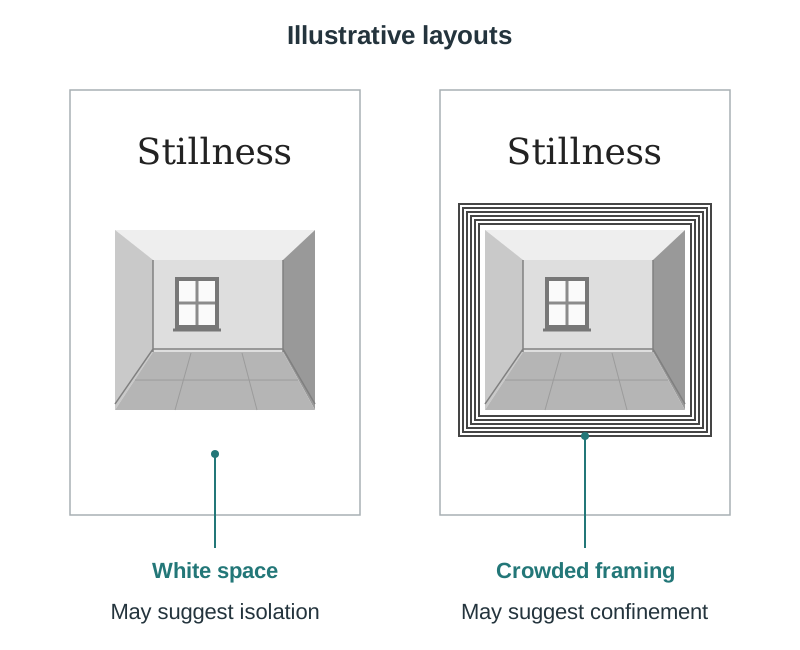
- Colour and contrast: Interpret colours within their actual context rather than applying rigid symbolic formulas. A stark black-and-white image of a deserted room removes warmth, emphasising stillness, decay, or isolation.
- White space: Deliberate empty space around an image or paragraph focuses the eye, suggests elegance, and improves readability, whereas cramped space creates a sense of frantic energy or claustrophobia.
- Text-image relationship: Examine how headlines or captions interact with images. A caption might clarify an ambiguous photograph, reinforce its emotional punch, or introduce deliberate irony.
Key terms
- PCLM Criteria
- The four marking criteria used across Leaving Certificate English: Clarity of Purpose (P), Coherence of Delivery (C), Efficiency of Language Use (L), and Accuracy of Mechanics (M).
- Insight
- A perceptive, inferential observation drawn from a close reading of a text, digging beneath surface summary to reveal underlying feelings, values, or character traits.
- In Your Own Words
- An examination directive requiring candidates to express ideas using their own vocabulary, keeping quotations short and using them strictly as supporting evidence.
- Stance
- A decisive, clear point of view adopted by a candidate when answering an evaluative prompt (such as 'To what extent do you agree?'), sustained throughout the entire response.
- Opinion vs Anecdote vs Evidence
- Three different kinds of material in an argument. An opinion is what the writer believes or judges; it does not prove anything by itself. An anecdote is a brief personal story used to illustrate a point. Evidence is verifiable facts, statistics, research findings or expert testimony.
- Assumptions
- Underlying premises or beliefs that a writer takes for granted without offering explicit proof, frequently signalling underlying ideological values or biases.
- Language of Information
- A mode of language focused on communicating facts and data, which students must evaluate for authorial perspective, assumed values, and deliberate omissions.
- Language of Argument
- Language that tries to convince through reasoning. The writer states a position, supports it with reasons and evidence, links ideas with words such as 'therefore' and 'because', may answer objections, and reaches a conclusion.
- Language of Persuasion
- A mode of language aimed at influencing beliefs or spurring action through emotional resonance, rhetorical devices, careful word choice, and audience targeting.
- Language of Narration
- A mode of language that constructs stories and life experiences, analysed through narrative perspective, characterisation, setting, pacing, and conflict.
- The Aesthetic Use of Language
- Artistic language that gives imaginative pleasure through sensory imagery, figurative techniques, sound patterning, and deliberate stylistic craft.
- Visual Literacy
- The ability to analyse how visual elements like layout, typography, colour, contrast, and framing construct meaning alongside written text.
Check yourself
If you answer Question B on Text 1, which texts can you choose from for Question A?
You may choose Question A from Text 2 or Text 3 only, as you cannot answer Question A and Question B on the same text.
What four marking criteria make up the PCLM framework in Leaving Certificate English?
Clarity of Purpose (P), Coherence of Delivery (C), Efficiency of Language Use (L), and Accuracy of Mechanics (M).
What must you do in your opening sentence when a prompt asks 'To what extent do you agree...?'
You must declare a clear stance stating the degree to which you agree, establishing an evaluative line of thought that runs through your whole answer.
What three kinds of material should you distinguish when reading an argument?
Opinion (what the writer believes or judges, which does not prove anything by itself), anecdote (a brief personal story used to illustrate a point), and evidence (verifiable facts, statistics, research findings, or expert testimony).
What does an examiner expect when a question asks you to answer 'in your own words'?
You must explain the author's ideas using your own phrasing, relying on quotation only as brief supporting evidence.
Name the five functions of language set out in the Leaving Certificate English syllabus.
The language of information, the language of argument, the language of persuasion, the language of narration, and the aesthetic use of language.