

William Butler Yeats (1865–1939) is one of the central figures of modern literature and a core poet on the Leaving Certificate Higher Level English course. His poetic journey spans more than five decades, moving from early romantic escapism through politically charged middle-period verse to the fierce, uncompromising reflections of his old age. On Paper 2, Section III (Prescribed Poetry), candidates answer one 50-mark essay on a chosen poet from a prescribed panel. The State Examinations Commission (SEC) evaluates this essay using four criteria under the PCLM system: Clarity of Purpose (15 marks), Coherence of Delivery (15 marks), Efficiency of Language Use (15 marks), and Accuracy of Mechanics (5 marks). High marks require a sustained personal thesis supported by close analysis of poetic technique, well-integrated quotation recalled from memory, and direct engagement with every element of the examination question.
How Section III is Examined at Higher Level
Paper 2, Section III (Poetry) carries 70 marks in total, split across two distinct parts:
- Part A – Unseen Poem (20 marks): A poem printed on the paper that you have not encountered on the course, accompanied by two short analytical questions. Every candidate must answer this section.
- Part B – Prescribed Poetry (50 marks): An extended analytical essay on one poet. The examination paper offers questions on a selection of the eight prescribed poets for the year, not all eight. You answer on one poet only.
Core Realities of the Exam Hall
- Yeats is not guaranteed to appear every year: The paper offers questions on a selection of the eight prescribed poets, not all eight, and the number of poets offered has varied in recent years — so always prepare at least two or three poets thoroughly. While Yeats appears regularly, you must never prepare only one poet.
- Prescribed poems are not printed on the paper: Unlike at Ordinary Level, the poems are not provided in the exam booklet for Higher Level candidates. Every quotation must be recalled accurately from memory. Memorising three or four short, versatile quotations per poem is far more effective than trying to retain entire stanzas.
- The PCLM mark breakdown: The 50 marks are divided into Clarity of Purpose (15), Coherence of Delivery (15), Efficiency of Language Use (15), and Accuracy of Mechanics (5). Purpose, coherence, and language carry identical weight. Leaving out one half of a two-part prompt or failing to back up assertions with textual evidence immediately caps your score.
- Timing and structure: Allocate roughly 50 minutes to Section III B. Spend 5 minutes dissecting the prompt and constructing an outline plan, 40 minutes writing five or six substantial, analytical paragraphs, and 5 minutes proofreading quotations, punctuation, and poem titles.
The Prescribed Poems and Core Thematic Tensions
The prescribed selection for 2027 runs from early lyricism to his final works: 'The Lake Isle of Innisfree', 'September 1913', 'The Wild Swans at Coole', 'An Irish Airman Foresees his Death', 'Easter 1916', 'The Second Coming', 'Sailing to Byzantium', 'from Meditations in Time of Civil War: VI, The Stare's Nest by My Window', 'In Memory of Eva Gore-Booth and Con Markiewicz', 'Swift's Epitaph', 'An Acre of Grass', and the final pairing 'from Under Ben Bulben: V and VI' and 'Politics'. Note that the official prescribed list prints 'from Under Ben Bulben: V and VI' and 'Politics' on a single line, so confirm the precise division your school is working with.
While the Department of Education requires studying at least six poems in class to understand the poet's breadth, an optimal exam essay examines four to five poems in depth. Yeats rarely offers simplistic answers; his most powerful work grows out of an ongoing argument with himself. SEC questions consistently focus on these central tensions:
| Tension | Core Conflict | Recommended Poems to Pair |
|---|---|---|
| Dream vs Reality | Longing for idealised solitude or spiritual refuge versus the grey facts of modern life | 'The Lake Isle of Innisfree', 'Sailing to Byzantium' |
| Youth vs Age | The vibrant, physical world contrasted with physical decay and marginalisation | 'The Wild Swans at Coole', 'Sailing to Byzantium', 'An Acre of Grass', 'Politics' |
| Body vs Soul / Intellect | The frailty of the mortal frame versus the enduring fire of creative imagination | 'Sailing to Byzantium', 'An Acre of Grass' |
| Art vs Nature | Fleeting biological life versus permanent, crafted aesthetic achievement | 'Sailing to Byzantium', 'Swift's Epitaph', 'from Under Ben Bulben: V and VI' |
| Idealism vs Violence / Fanaticism | Selfless political devotion versus moral rigidity, bloodshed, and social ruin | 'September 1913', 'Easter 1916', 'The Second Coming', 'The Stare's Nest by My Window' |
| Public Duty vs Private Feeling | The demands of national movements versus personal desire and private autonomy | 'An Irish Airman Foresees his Death', 'Easter 1916', 'Politics', 'In Memory of Eva Gore-Booth and Con Markiewicz' |
| Past Heroism vs Present Complacency | Romantic sacrifice of historical martyrs versus petty commercial self-interest | 'September 1913', 'Easter 1916' |
Nature, Escapism, and Transience: Innisfree and Coole Park
Only one poem on the course, 'The Lake Isle of Innisfree', comes from Yeats's early Celtic Revival period, with its lush sensory imagery and longing to escape the modern city; almost everything else studied is middle or late Yeats. In 'The Lake Isle of Innisfree', Yeats imagines an idyllic refuge on Lough Gill in County Sligo. Written in three quatrains rhyming ABAB CDCD EFEF, the poem relies on soft alliteration and assonance—'lake water lapping with low sounds by the shore'—to evoke peace. He envisions a self-sufficient life with 'nine bean-rows' and 'a hive for the honey-bee', where 'peace comes dropping slow'. Yet the final stanza grounds this paradise in an emotional ache. Standing 'on the roadway, or on the pavements grey', the speaker hears the lake water only 'in the deep heart's core'. The sanctuary remains a mental desire rather than an achieved physical departure.
'The Wild Swans at Coole' takes a much colder look at nature. Visiting Lady Gregory's estate in autumn, the ageing speaker counts fifty-nine swans. Unlike the poet, whose heart has grown sore over nineteen years, the swans are 'Unwearied still, lover by lover'. Their passionate energy in the 'cold / Companionable streams' highlights his own advancing age. When they 'All suddenly mount / And scatter wheeling in great broken rings', their flight mirrors human transience. Nature here does not offer comfort; it provides a painful contrast between animal vitality and mortal decline.
Public Upheaval and National Identity: 1913 to 1918
Yeats's middle period charts Ireland's turbulent political emergence. In 'September 1913', written during the Dublin Lockout, he attacks the emerging Catholic merchant class for their spiritual meanness, sneering that they 'fumble in a greasy till / And add the halfpence to the pence' alongside dry, 'shivering prayer'. He contrasts this commercial small-mindedness with past heroes like Edward Fitzgerald, Robert Emmet, and Wolfe Tone, who 'weighed so lightly what they gave'. The bitter refrain, 'Romantic Ireland's dead and gone, / It's with O'Leary in the grave', laments the loss of an unselfish nationalist ideal.
The Easter Rising shattered that cynicism and forced Yeats to reassess his assumptions. In 'Easter 1916', he confesses that he once dismissed the rebels with 'polite meaningless words'. Their willingness to die transforms ordinary acquaintances into tragic figures. Even John MacBride, whom Yeats disliked intensely, is granted a place in the memorial roll call. This upheaval is captured in the oxymoron of the famous refrain: 'All changed, changed utterly: / A terrible beauty is born.'
Yet the poem refuses simple patriotic celebration. Yeats introduces the troubling symbol of the stone: 'Hearts with one purpose alone / Through summer and winter seem / Enchanted to a stone / To trouble the living stream.' While the stone represents heroic endurance, it also petrifies the human heart, disrupting the moving current of ordinary life represented by the rider, the horse, and the tumbling clouds. Asking 'Was it needless death after all?', Yeats explores the dangerous fanaticism that political sacrifice demands.
In 'An Irish Airman Foresees his Death' (1918), commemorating Major Robert Gregory, Yeats subverts traditional wartime elegies. Written as a sixteen-line dramatic monologue in steady iambic tetrameter, the pilot rejects imperial loyalty, duty, and public praise: 'Those that I fight I do not hate, / Those that I guard I do not love.' His allegiance belongs only to his local tenantry: 'My country is Kiltartan Cross, / My countrymen Kiltartan's poor'. What drives him is something else entirely: 'A lonely impulse of delight / Drove to this tumult in the clouds.' Looking forward and back, 'The years to come seemed waste of breath, / A waste of breath the years behind'. The airman wins a kind of freedom: he chooses his own death on his own terms, and that is both heroic and terribly lonely.
Apocalypse, Civil War, and Political Disillusion
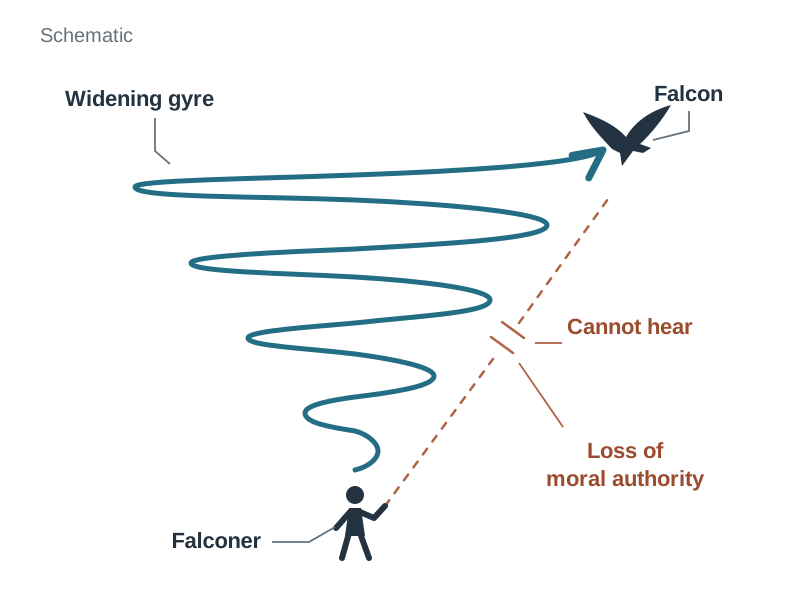
Written in 1919 in the shadow of World War I and the Russian Revolution, 'The Second Coming' envisions global collapse through Yeats's mystical theory of historical gyres (conical 2,000-year historical cycles). The opening image of the falcon losing touch with the falconer symbolises humanity breaking free from moral authority: 'Things fall apart; the centre cannot hold; / Mere anarchy is loosed upon the world'. As the 'blood-dimmed tide' drowns innocence, moral authority disintegrates: 'The best lack all conviction, while the worst / Are full of passionate intensity.' Drawing on the Spiritus Mundi (the collective cosmic memory), Yeats summons a terrifying vision: a 'shape with lion body and the head of a man' whose gaze is 'blank and pitiless as the sun'. The Christian era of 'twenty centuries of stony sleep' has ended, and a 'rough beast' slouches towards Bethlehem to inaugurate a brutal new epoch.
This civilisational nightmare hits home in 'from Meditations in Time of Civil War: VI, The Stare's Nest by My Window' (1922). Note that a stare is a starling. Confined to his tower while violence rages outside, Yeats watches an empty nest in the stonework. His recurrent refrain—'O honey-bees, / Come build in the empty house of the stare'—serves as an earnest appeal for creative renewal and community healing. He acknowledges how civil war corrupts human compassion: 'We had fed the heart on fantasies, / The heart's grown brutal from the fare', admitting with grief that there is 'More substance in our enmities / Than in our love'.
A similar political tragedy unfolds in 'In Memory of Eva Gore-Booth and Con Markiewicz' (note that the prescribed title uses 'Con Markiewicz', while modern historical accounts usually spell the surname Markievicz). The poem begins with a nostalgic memory of Lissadell House: 'Two girls in silk kimonos, both / Beautiful, one a gazelle.' In the body of the poem Yeats blames politics for what they became: Markievicz 'Conspiring among the ignorant', Eva dreaming 'Some vague Utopia' until she is 'withered old and skeleton-gaunt', 'An image of such politics'. But in the final movement he changes ground. Addressing the 'Dear shadows', he calls the whole 'fight / With a common wrong or right' a 'folly', and insists that 'The innocent and the beautiful / Have no enemy but time'. The effect is double-edged: politics wasted them, yet from the far side of death even that waste looks trivial beside time itself—a characteristic Yeatsian refusal to settle.
Old Age, Art, and Legacy
In his later poetry, Yeats confronts bodily decline by looking to the permanence of art. 'Sailing to Byzantium' (1928) opens with an emphatic rejection of biological life: 'That is no country for old men.' Leaving behind Ireland's sensual world of 'dying generations', the speaker sails to Byzantium, an idealised city of artistic and spiritual perfection. He acknowledges his decaying body as merely 'A tattered coat upon a stick' unless the soul can 'clap its hands and sing'. Praying to the mosaic figures in 'God's holy fire', he asks them to 'Consume my heart away; sick with desire / And fastened to a dying animal'. Once released from the physical form, he resolves to take the shape of an artificial bird of 'hammered gold and gold enamelling', crafted by 'Grecian goldsmiths' to sing eternally 'Of what is past, or passing, or to come'. The poem's disciplined ottava rima (abababcc in iambic pentameter) gives formal permanence to the art it praises.
In 'An Acre of Grass', Yeats resists quiet domestic resignation. Confined to an old house where 'nothing stirs but a mouse', he refuses to let his mind decay: 'Grant me an old man's frenzy, / Myself must I remake'. Invoking William Blake and Michelangelo, he seeks an 'eagle mind' capable of piercing the clouds and shaking the dead in their shrouds, demanding visionary fire in the face of death.
'Swift's Epitaph' translates Jonathan Swift's Latin epitaph into six sharp lines. Yeats presents his 18th-century hero as having found peace: 'Swift has sailed into his rest; / Savage indignation there / Cannot lacerate his breast.' The poem then challenges the reader directly: 'Imitate him if you dare, / World-besotted traveller; he / Served human liberty.' Yeats celebrates a fierce intellect that fought corruption, measuring greatness by devotion to freedom.
'from Under Ben Bulben: V and VI' serves as Yeats's poetic testament. In Section V he commands his successors: 'Irish poets, learn your trade, / Sing whatever is well made', urging them to preserve tradition so Ireland remains 'Still the indomitable Irishry'. In Section VI, picturing his burial under bare Ben Bulben in Drumcliff churchyard, he dictates the epitaph cut into limestone by his command: 'Cast a cold eye / On life, on death. / Horseman, pass by!' The word 'cold' demands an unsentimental gaze, while the 'Horseman' recalls the aristocratic, heroic spirit he celebrated throughout his life.
Finally, 'Politics' carries an epigraph from Thomas Mann: 'In our time the destiny of man presents its meanings in political terms.' The poem is Yeats's direct refusal of that claim. Hearing politicians debate international crises in Rome, Russia, and Spain, he sets world affairs aside for an immediate encounter: 'How can I, that girl standing there, / My attention fix / On Roman or on Russian / Or on Spanish politics?' Admitting that warnings of war may be real, he finishes with an honest personal cry: 'But O that I were young again / And held her in my arms!' Ending his collection with this lyric, Yeats insists that human passion outlasts public ideology.
The Toolkit: Handling History, Myth, and Technique
Approaching Questions on History, Myth, and Legend
When exam prompts ask about history, myth, or legend (as in 2022), you do not need different poems; you need to organise your poems around these concepts:
- History as Public Events: The 1913 Lockout in 'September 1913'; the 1916 Rising in 'Easter 1916'; World War I in 'An Irish Airman Foresees his Death'; the Civil War in 'The Stare's Nest by My Window'.
- History as Named Individuals: Tone, Emmet, Fitzgerald, and O'Leary in 'September 1913'; MacDonagh, MacBride, Connolly, and Pearse in 'Easter 1916'; Robert Gregory in 'An Irish Airman'; Eva Gore-Booth and Constance Markievicz; Jonathan Swift. Naming real individuals grounds broad political ideas in human tragedy.
- Myth and Visionary Lore: The Spiritus Mundi and the sphinx-like beast in 'The Second Coming'; the holy city of Byzantium and its golden bird; the heroic creative figures of Blake and Michelangelo in 'An Acre of Grass'; the 'indomitable Irishry' of 'Under Ben Bulben'.
Core Poetic Techniques to Name and Analyse
Avoid vague appreciation; name specific devices and explain how they construct meaning:
- Symbolism: The stone representing stubborn dedication in 'Easter 1916'; the swans signifying timeless beauty at Coole; the falcon and falconer showing broken authority in 'The Second Coming'; the empty stare's nest representing a fractured society.
- Refrain: 'Romantic Ireland's dead and gone', 'A terrible beauty is born', 'Come build in the empty house of the stare'. Each return gathers new meaning from the stanzas that precede it.
- Antithesis and Balanced Phrasing: 'Those that I fight I do not hate, / Those that I guard I do not love.'
- Oxymoron: 'terrible beauty'.
- Rhetorical Questions: 'Was it needless death after all?'; 'How can I, that girl standing there, / My attention fix...?'
- Direct Address and Imperatives: 'Imitate him if you dare'; 'Irish poets, learn your trade'; 'Horseman, pass by!'
- Verse Form as Meaning: The disciplined ottava rima of 'Sailing to Byzantium' embodying artistic permanence; the driving iambic tetrameter of 'An Irish Airman' matching the pilot's clear-headed logic; the fractured rhythms of 'The Second Coming' enacting social breakdown.
Essential Quotation Bank by Thematic Tension
Use this quick-reference quotation bank to revise key evidence for your comparative paragraphs:
- Dream vs Reality:
- 'lake water lapping with low sounds by the shore' ('The Lake Isle of Innisfree')
- 'While I stand on the roadway, or on the pavements grey' ('The Lake Isle of Innisfree')
- 'I hear it in the deep heart's core.' ('The Lake Isle of Innisfree')
- 'That is no country for old men.' ('Sailing to Byzantium')
- Youth vs Age & The Mortal Body:
- 'Their hearts have not grown old; / Passion or conquest, wander where they will' ('The Wild Swans at Coole')
- 'An aged man is but a paltry thing, / A tattered coat upon a stick' ('Sailing to Byzantium')
- 'Consume my heart away; sick with desire / And fastened to a dying animal' ('Sailing to Byzantium')
- 'Grant me an old man's frenzy, / Myself must I remake' ('An Acre of Grass')
- 'An old man's eagle mind.' ('An Acre of Grass')
- 'But O that I were young again / And held her in my arms.' ('Politics')
- Idealism, Fanaticism, and War:
- 'Romantic Ireland's dead and gone, / It's with O'Leary in the grave.' ('September 1913')
- 'They weighed so lightly what they gave' ('September 1913')
- 'All changed, changed utterly: / A terrible beauty is born.' ('Easter 1916')
- 'Enchanted to a stone / To trouble the living stream.' ('Easter 1916')
- 'Was it needless death after all?' ('Easter 1916')
- 'A lonely impulse of delight / Drove to this tumult in the clouds' ('An Irish Airman Foresees his Death')
- 'The best lack all conviction, while the worst / Are full of passionate intensity.' ('The Second Coming')
- 'We had fed the heart on fantasies, / The heart's grown brutal from the fare' ('The Stare's Nest by My Window')
- 'More substance in our enmities / Than in our love' ('The Stare's Nest by My Window')
- Art, Legacy, and Immortality:
- 'hammered gold and gold enamelling' ('Sailing to Byzantium')
- 'Of what is past, or passing, or to come.' ('Sailing to Byzantium')
- 'Savage indignation there / Cannot lacerate his breast.' ('Swift's Epitaph')
- 'Imitate him if you dare, / World-besotted traveller; he / Served human liberty.' ('Swift's Epitaph')
- 'Irish poets, learn your trade, / Sing whatever is well made' ('from Under Ben Bulben: V and VI')
- 'Cast a cold eye / On life, on death. / Horseman, pass by!' ('from Under Ben Bulben: V and VI')
Key terms
- PCLM Criteria
- The marking rubric applied by SEC examiners for Leaving Certificate English: Clarity of Purpose (15 marks), Coherence of Delivery (15 marks), Efficiency of Language Use (15 marks), and Accuracy of Mechanics (5 marks).
- Gyre
- A conical spiral used in Yeats's philosophy to illustrate cyclical historical epochs lasting 2,000 years, each exhausting itself before collapsing into its opposite.
- Spiritus Mundi
- A Latin term for the 'world soul' or collective racial memory, containing universal archetypes and images that Yeats drew on for visionary poems like 'The Second Coming'.
- Ottava Rima
- An eight-line Italian stanza form rhyming abababcc in iambic pentameter, used in 'Sailing to Byzantium' to establish classical order, balance, and aesthetic permanence.
- The Stone
- The recurring symbol in 'Easter 1916' representing unyielding political purpose that gains lasting fame but petrifies human feeling and disrupts normal life.
- Oxymoron
- A figure of speech pairing contradictory terms to reveal a difficult truth, central to the refrain 'A terrible beauty is born' in 'Easter 1916'.
- Dramatic Monologue
- A poetic form in which an imagined character speaks directly to the reader or an implied audience, revealing their inner mindset, as in 'An Irish Airman Foresees his Death'.
- Refrain
- A line or phrase repeated at intervals throughout a poem, used by Yeats to develop emotional complexity and drive home shifting arguments across stanzas.
- Antithesis
- The balanced pairing of contrasting phrases or ideas, evident in the airman's reasoning: 'Those that I fight I do not hate, / Those that I guard I do not love'.
- Stare
- A dialect word for a starling, used in 'The Stare's Nest by My Window' to describe the bird whose deserted nest in the masonry highlights the civil war around the tower.
Check yourself
What central oxymoron forms the refrain of 'Easter 1916', and what paradox does it express?
'A terrible beauty is born.' It captures the paradox that an inspiring national consciousness arose out of violent destruction and tragic loss.
What verse form is used in 'Sailing to Byzantium', and how does its formal design reinforce the poem's theme?
Ottava rima (eight-line stanzas rhyming abababcc in iambic pentameter). Its polished, disciplined architecture formally reflects the eternal, unageing perfection of the art it celebrates.
What is the primary motivation driving the pilot in 'An Irish Airman Foresees his Death'?
He rejects law, duty, public men, and cheering crowds, declaring that he was driven solely by 'A lonely impulse of delight' among the clouds.
In 'The Second Coming', what does the image of the falcon failing to hear the falconer signify?
It symbolises humanity losing connection with traditional moral authority, initiating an era of breakdown where 'the centre cannot hold'.
How does the tone shift between the opening and closing stanzas of 'An Acre of Grass'?
It moves from quiet, resigned contemplation of physical frailty ('My temptation is quiet') to a fierce, passionate demand for creative renewal ('Grant me an old man's frenzy') through the 'eagle mind'.
What does the repeated bee refrain represent in 'The Stare's Nest by My Window'?
It represents an urgent, fragile plea for natural sweetness, constructive labour, and community healing amid the self-destructive violence of the Irish Civil War.
How many marks are allocated to Section III B (Prescribed Poetry) on Paper 2, and what are the four PCLM criteria?
50 marks: Clarity of Purpose (15 marks), Coherence of Delivery (15 marks), Efficiency of Language Use (15 marks), and Accuracy of Mechanics (5 marks).