

John Donne (1572–1631) is the central figure of metaphysical poetry, renowned for fusing intense emotion with rigorous intellectual argument. Prescribed for Leaving Certificate Higher Level 2027, Donne abandons decorative Elizabethan conventions in favour of dramatic conversational rhythms, striking conceits, and audacious paradoxes. Ten poems are prescribed for Higher Level in the official 2027 syllabus, with candidates expected to study at least six. This note works through all ten prescribed poems and shows how Donne's speakers debate, scold, celebrate and plead their way towards romantic and divine truth.
The Donne Question on Paper 2: Structure, Timing, and Marks
Donne appears on English Paper 2, Section III (designated Section C in the syllabus specification), which covers Poetry. The section is worth 70 marks total and divides into two distinct tasks:
- Section III Part A: Unseen Poetry (20 marks). A poem you have not studied, printed on the exam paper, accompanied by short questions.
- Section III Part B: Prescribed Poetry (50 marks). A choice of essay questions on several prescribed poets. You must answer on one poet only.
Practical Exam Realities
- Timing and Length: The prescribed poetry essay carries 50 marks. Allocate approximately 50 minutes to it in the examination, aiming for four to five well-structured written pages.
- The PCLM Marking Scheme: Marks are distributed across Clarity of Purpose (15 marks), Coherence of Delivery (15 marks), Efficiency of Language (15 marks), and Accuracy of Mechanics (5 marks). Purpose and Coherence make up 30 of the 50 marks: answering the exact words of the prompt with a progressive argument matters far more than reciting memorised notes.
- Poems Are Not Printed: Unlike Ordinary Level, poems are not printed on the Higher Level examination paper. Every quotation must be recalled from memory. Learn three or four short, precise phrases per poem rather than long stanzas that collapse under exam pressure.
- Choice of Poets: Eight poets are prescribed, but only four or five appear on any given paper. Never study Donne in isolation; always prepare Donne alongside at least one other prescribed poet in equal depth.
Context and the Metaphysical Style
Donne's love lyrics circulated in manuscript during his early life and were published posthumously in the 1633 collection Songs and Sonnets. His devotional poetry, including the Holy Sonnets, dates largely from his later years of spiritual crisis and clerical duty. Born into an Elizabethan Roman Catholic family during an era of anti-Catholic persecution, Donne conformed to the Church of England in adulthood, was ordained in 1615, and was appointed Dean of St Paul's Cathedral in 1621. While biography can briefly contextualise why the same speaker pleads with equal passion to a mistress and to God, biographical detail earns no marks in isolation on Paper 2. Use it only to explain the emotional pressure behind the verse.
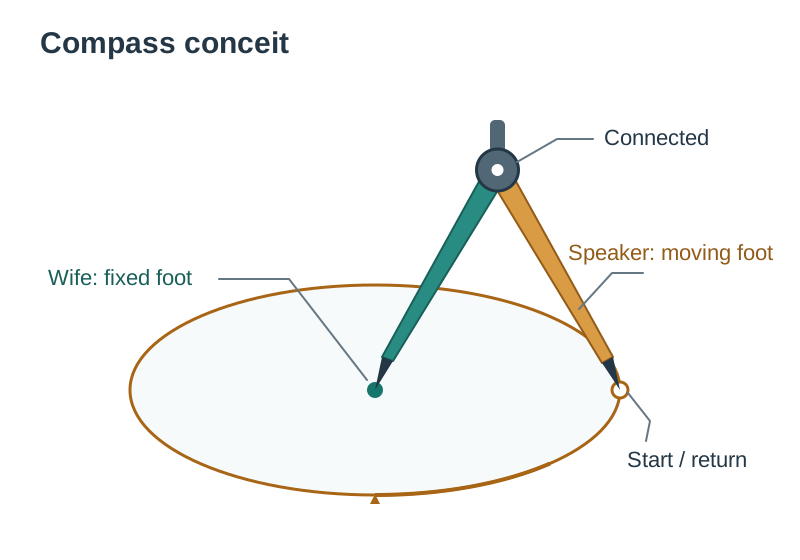
Metaphysical poetry rejects idealised, decorative verse in favour of urgent, colloquial speech. The central vehicle of Donne's style is the metaphysical conceit: an extended, intellectually rigorous comparison between two seemingly disparate entities. Rather than relying on standard similes, Donne pursues his comparisons through relentless logic. In A Valediction: Forbidding Mourning, separated lovers are compared to the two legs of a draughtsman's compass — a pair of compasses, the instrument you use to draw a circle. In The Flea, an insect bite is transformed into a sacred wedding chapel.
The Four-Step Reading Method
To analyse any metaphysical poem systematically in an examination, work through these four stages:
- Situation: Who is speaking, who is being addressed, and what immediate tension triggers the speech?
- Motive: What does the speaker want the listener to concede, believe, or do?
- Volta / Shift: Where does the argument pivot, and what causes that transition?
- Technique & Sound: How do metre, rhythm, paradox, imagery, and syntax reveal the speaker's emotional state?
Tone: The Dramatic Voices of Donne
Donne's speakers almost never sound calm or detached. Each lyric opens in the middle of an unresolved situation (in media res), adopting an immediate persona. In the Leaving Certificate marking notes, identifying tone and tracking its shifts is explicitly rewarded.
| Prescribed Poem | Dominant Tone | Defining Line |
|---|---|---|
| The Sunne Rising | Mock-angry, then triumphant and boastful | "Busy old fool, unruly sun" |
| The Anniversarie | Confident, celebratory, quietly assured | "Only our love hath no decay" |
| Song: Sweetest love, I do not goe | Tender, consoling, faintly anxious | "When thou weep'st, unkindly kind" |
| A Valediction: Forbidding Mourning | Controlled, reasoned, superior | "So let us melt, and make no noise" |
| The Flea | Teasing, mock-legal, opportunistic | "Mark but this flea, and mark in this" |
| The Dreame | Delighted, reverent, then suspicious and deflated | "But rising makes me doubt" |
| Song: Go, and catch a falling star | Flippant, satirical, world-weary | "No where / Lives a woman true, and fair" |
| Batter my heart | Desperate, violent, self-accusing | "break, blow, burn, and make me new" |
| At the round earth's imagined corners | Grand and commanding, then terrified and humble | "But let them sleep, Lord, and me mourn a space" |
| Thou hast made me | Fearful, pleading, exhausted | "Repair me now, for now mine end doth haste" |
Merely labelling a tone earns minimal credit. You must track how the tone moves. In At the round earth's imagined corners, the speaker begins by arrogantly ordering the angels of the apocalypse to blow their trumpets, but suddenly halts at line 9. The tonal collapse from imperial command to desperate plea is the poem's core meaning: the man summoning Judgement Day suddenly realises his own soul is unready to face God.
Structure, Metre, and Rhythm
Donne manipulates traditional poetic structures to dramatise psychological tension.
| Form / Element | Usage in Prescribed Poems | Dramatic & Emotional Effect |
|---|---|---|
| Petrarchan Sonnet | Batter my heart, At the round earth's imagined corners, Thou hast made me | An eight-line octave (ABBAABBA) establishes an acute spiritual crisis. Across the volta, a six-line sestet seeks resolution, although in Donne's hands it often intensifies personal terror rather than resolving it. |
| Sestets ending in a couplet | CDCDEE in Batter my heart, CDCDEE in At the round earth's imagined corners | Blends the unresolved tension of the Italian sestet with the decisive punch of an English rhyming couplet, making the final lines land like a definitive verdict. |
| Trochaic Substitution | Initial stressed beats: "BAT-ter my heart", "BU-sy old fool" | Replaces a regular unstressed-stressed iamb with a heavy falling foot, injecting conversational aggression directly into the opening line. |
| Varied line lengths | Song: Go, and catch a falling star | Each nine-line stanza runs through four short lines, a longer couplet, two clipped two-syllable lines ("And swear / No where"), and a final long line. The two-syllable lines snap shut like a trap, accelerating the satirical punchline. |
| Stanza-by-stanza argument | Three 10-line stanzas in The Sunne Rising; three 9-line stanzas in The Flea | Provides distinct psychological stages where the speaker alters tactics as his listener resists or circumstances change. |
Persuasion and Cynicism: The Flea, The Dreame, and Falling Star
Donne frequently explores romantic relationships through provocative, manipulative, or satirical personas.
The Flea
The Flea is a masterclass in seduction by specious logic. Rather than arguing from the fleeting nature of time, the speaker constructs an audacious mock-legal and mock-theological case across three nine-line stanzas:
- Stanza 1 (Minimising the Act): The speaker points to a flea that has bitten them both: "mark in this, / How little that which thou deniest me is". Because their blood is already mingled inside the parasite, he argues that physical intimacy cannot be termed "A sin, nor shame, nor loss of maidenhead".
- Stanza 2 (Sanctifying the Insect): As the woman raises her hand to kill the flea, he elevates the insect into a holy space: "This flea is you and I, and this / Our marriage bed, and marriage temple is". Playing audaciously with the Christian Trinity ("three lives in one"), he warns that killing the flea would be "sacrilege, three sins in killing three".
- Stanza 3 (Inverting the Defeat): The woman ignores his rhetoric and crushes the flea with her fingernail. Unflustered, the speaker instantly pivots. Just as she proved the flea's death caused no bodily harm, so yielding her honour to him will prove equally harmless: "Just so much honour, when thou yield'st to me, / Will waste, as this flea's death took life from thee".
Higher Level analysis must look at the silent listener: the mistress's physical action in killing the insect completely punctures the speaker's elaborate intellectual display. Her practical gesture exposes his grand theology as playful, opportunistic nonsense.
The Dreame
The speaker awakens from a passionate dream to find his beloved standing in his bedroom: "My dream thou brok'st not, but continued'st it". Because she can read his internal thoughts — an ability "beyond an angel's art" in Renaissance theology — he flatters her as divine.
Yet as she rises to depart, the reverent tone curdles into suspicion: "Coming and staying show'd thee, thee, / But rising makes me doubt, that now / Thou art not thou." He argues that true love must be "all spirit, pure and brave", free from "fear, shame, honour". Comparing her to someone testing torches ("Perchance as torches, which must ready be, / Men light and put out, so thou deal'st with me"), he deflates his own idealisation, suspecting her of calculated emotional manipulation.
Song: Go, and catch a falling star
Adopting a world-weary persona, the speaker lists a catalogue of mythical and folklore impossibilities: "Go and catch a falling star", "Get with child a mandrake root", and "hear mermaids singing". In stanza two, he reveals his cynical premise: even if a traveller rode "ten thousand days and nights" until "age snow white hairs on thee", he would report that "No where / Lives a woman true, and fair". The final stanza sharpens the speaker's misogyny: even if an honest woman lived next door, she would turn "False, ere I come, to two, or three". While the lively rhythm and rhyming couplets entertain, an alert candidate notes that this satire reveals the speaker's wounded insecurity rather than an objective truth about human nature.
Cosmic Love and Parting: The Sunne Rising, The Anniversarie, and the Valedictions
When Donne turns away from cynical postures, he presents mutual love as an absolute, self-contained realm capable of overcoming time and geographic separation.
The Sunne Rising and The Anniversarie
In The Sunne Rising, the speaker berates the daylight through an indignant apostrophe: "Busy old fool, unruly sun". Scorning the everyday world of "late school boys" and "country ants", he claims that "Love, all alike, no season knows nor clime, / Nor hours, days, months, which are the rags of time". Drawing on the Renaissance concept of the microcosm — where an intimate space encapsulates the whole world — he contracts the entire globe into the bedroom:
"She's all states, and all princes, I, / Nothing else is."
Since the lovers embody all nations and rulers, the sun's universal duty can be accomplished by shining on them alone: "Thine age asks ease, and since thy duties be / To warm the world, that's done in warming us. / Shine here to us, and thou art everywhere; / This bed thy centre is, these walls, thy sphere."
The Anniversarie strikes an equally celebratory note. Marking their first year together, the speaker notes that kings, courts, and the sun have aged, yet "Only our love hath no decay". While physical bodies must eventually enter "Two graves", their souls will triumph: "When bodies to their graves, soules from their graves remove". Within their private kingdom, they enjoy sovereign equality: "Here upon earth, we'are kings, and none but wee / Can be such Kings, nor of such subjects bee."
A Valediction: Forbidding Mourning and Song: Sweetest love, I do not goe
A valediction is a farewell speech. In A Valediction: Forbidding Mourning, Donne consoles his wife Anne More prior to his travel abroad, urging her that their farewell should resemble the quiet passing of holy men: "So let us melt, and make no noise".
| Dimension | Dull Sublunary Love | Refined Spiritual Love |
|---|---|---|
| Meaning & Foundation | Sublunary (literally beneath the moon, subject to change and decay); entirely reliant on sensory presence ("Whose soul is sense") | Spiritually refined; founded upon internal mental certainty ("Inter-assured of the mind") |
| Reaction to Absence | Cannot tolerate distance; physical absence destroys the bond entirely | Care less "eyes, lips, and hands to miss" |
| Effect of Separation | A catastrophic rupture or physical fracture | An expansion: "Like gold to airy thinness beat" |
The poem reaches its climax in the famous compass conceit. His wife is the fixed foot anchored in the centre, while he is the roaming outer foot. Her stability preserves his trajectory: "Thy firmness makes my circle just, / And makes me end where I begun."
In Song: Sweetest love, I do not goe, written in fluid eight-line lyric stanzas, the speaker comforts his weeping partner by comparing his journey to the sun's reliable cycle, boasting "More wings and spurs than he". He describes separations as "feign'd deaths" that prepare lovers for mortality, and chides her tears as self-wounding contradictions: "When thou weep'st, unkindly kind, / My life's blood doth decay". He concludes with the philosophical assurance that lovers who keep each other alive in their minds "ne'er parted be".
The Holy Sonnets: Spiritual Anguish and Divine Intervention
Donne's religious verse displays the same passionate dialectic as his secular lyrics. The Holy Sonnets dramatise a soul wracked by guilt, terrified of mortality, and utterly reliant on divine grace (God's freely given, unearned mercy).
Batter my heart, three-person'd God (Holy Sonnet 14)
Beginning with an explosive trochaic substitution ("BAT-ter"), the speaker rejects gentle divine intervention: "for you / As yet but knock, breathe, shine, and seek to mend". He demands violent, radical renovation: "break, blow, burn, and make me new". Two conceits drive the poem:
- The Usurped Town (Octave): The speaker compares his soul to "an usurp'd town to another due". Human reason, God's viceroy, has been "captived" by sin and fails to defend him.
- The Unwanted Engagement (Sestet): Across the volta ("Yet dearly I love you"), he confesses: "But am betroth'd unto your enemy; / Divorce me, untie or break that knot again".
The sonnet concludes with startling paradoxes: "Except you enthral me, never shall be free, / Nor ever chaste, except you ravish me." True spiritual liberty requires divine imprisonment; soul purity requires God to forcefully overpower human weakness.
At the round earth's imagined corners (Holy Sonnet 7)
In the octave, the speaker paints a theatrical vision of the Last Judgement. Reconciling scientific geography with Revelation 7:1, he commands the archangels: "blow / Your trumpets, angels, and arise, arise". Employing anaphora, he lists all who have died: "All whom war, dearth, age, agues, tyrannies, / Despair, law, chance hath slain" (where "dearth" signifies famine and "agues" violent fevers).
At line 9, the volta arrives abruptly with "But": "But let them sleep, Lord, and me mourn a space". Terrified by his own unreadiness, the speaker shrinks from the cosmic drama. He begs for earthly time to master repentance: "Teach me how to repent; for that's as good / As if thou hadst seal'd my pardon with thy blood."
Thou hast made me (Holy Sonnet 1)
The sequence opens with a stark question: "Thou hast made me, and shall thy work decay?" The speaker feels mortality rushing upon him: "Repair me now, for now mine end doth haste". Looking back, he sees accumulated sins; looking forward, death threatens his wasting flesh.
The sonnet rests on a simple doctrine: human beings cannot rescue themselves. The speaker cannot resist the "old subtle foe" "one hour" by his own strength, so everything depends on grace. In the sestet, Donne establishes a dynamic spatial struggle between two opposite directions: sin exerts a downward gravitational pull toward hell, while grace pulls him upward:
"Only thou art above, and when towards thee / By thy leave I can look, I rise again"
The poem resolves through an arresting conceit of divine magnetism, where "adamant" means a powerful magnet or lodestone: "Thy grace may wing me to prevent his art, / And thou like adamant draw mine iron heart."
Arguing Against the Statement: Building a Qualified Position
You are never required to agree unconditionally with the examination prompt. Leaving Certificate marking schemes explicitly reward qualified agreement, provided your argument is reasoned and supported with evidence. If a prompt asserts that Donne's conceits provide profound insight into human nature, two clear lines of counter-argument can earn high marks:
- Ingenuity Can Crowd Out Feeling: The compass conceit in A Valediction: Forbidding Mourning is an intellectual marvel, yet a reader may legitimately argue that geometric calculations replace human grief. The speaker is so busy proving why parting is inconsequential that the genuine pain of absence is silenced. Contrast this with the moving vulnerability in Song: Sweetest love, I do not goe — "When thou weep'st, unkindly kind, / My life's blood doth decay" — where logical argument gives way to heartfelt distress.
- Arguments Are Sometimes Specious Displays: The logic in The Flea is deliberately absurd. Equating an insect bite to a "marriage temple" is a theatrical trick rather than a philosophical truth, and the mistress easily exposes this by crushing the insect. When an exam question claims Donne's poems offer serious philosophical investigations, you can demonstrate that some lyrics are dynamic verbal performances designed to win an immediate debate rather than establish moral truth.
How to Phrase a Qualification
"While I agree that Donne frequently achieves profound emotional depth, I would qualify the statement by observing that in The Flea, intellectual ingenuity becomes an elaborate game: the speaker's specious theology is a theatrical mask for sexual conquest rather than a genuine exploration of love." Then return to your central thesis. A well-placed qualification demonstrates critical independence.
Essential Quotation Bank
Because poems are not printed on the Higher Level paper, you must memorise concise, multipurpose quotations. Learn these key lines across the prescribed poems:
- The Sunne Rising: "Busy old fool, unruly sun" / "the rags of time" / "She's all states, and all princes, I" / "This bed thy centre is, these walls, thy sphere"
- The Anniversarie: "Only our love hath no decay" / "Two graves must hide thine and my corse" / "Here upon earth, we'are kings"
- Song: Sweetest love, I do not goe: "More wings and spurs than he" / "When thou weep'st, unkindly kind" / "Alive, ne'er parted be"
- A Valediction: Forbidding Mourning: "So let us melt, and make no noise" / "Dull sublunary lovers' love" / "Like gold to airy thinness beat" / "Thy firmness makes my circle just"
- The Flea: "How little that which thou deniest me is" / "Our marriage bed, and marriage temple is" / "three lives in one flea spare" / "Just so much honour, when thou yield'st to me, / Will waste"
- The Dreame: "My dream thou brok'st not, but continued'st it" / "beyond an angel's art" / "Coming and staying show'd thee, thee, / But rising makes me doubt"
- Song: Go, and catch a falling star: "Go and catch a falling star" / "No where / Lives a woman true, and fair" / "False, ere I come, to two, or three"
- Batter my heart: "break, blow, burn, and make me new" / "an usurp'd town to another due" / "betroth'd unto your enemy" / "Except you enthral me, never shall be free, / Nor ever chaste, except you ravish me"
- At the round earth's imagined corners: "blow / Your trumpets, angels, and arise, arise" / "war, dearth, age, agues, tyrannies" / "But let them sleep, Lord, and me mourn a space" / "Teach me how to repent"
- Thou hast made me: "Repair me now, for now mine end doth haste" / "I run to death, and death meets me as fast" / "Only thou art above" / "thou like adamant draw mine iron heart"
Key terms
- Metaphysical Conceit
- An extended, intellectually ingenious comparison between two seemingly disparate entities, developed through sustained, logical argument (such as lovers compared to a pair of compasses).
- Volta
- The structural and emotional turning point in a sonnet, typically occurring between the octave and sestet, marking a fundamental pivot in thought, tone, or perspective.
- Paradox
- An apparent contradiction that reveals a deeper psychological, romantic, or spiritual truth upon closer inspection (such as achieving chastity through ravishment).
- Microcosm
- The Renaissance philosophical concept that an intimate personal space or individual body contains and reflects the entire macrocosm of the universe.
- Sublunary
- Literally beneath the moon; belonging to the physical earth and therefore subject to change, decay, and time.
- Trochaic Substitution
- Replacing an expected rising iamb (unstressed-stressed) with a falling trochee (stressed-unstressed) at the start of a poetic line to create abrupt conversational emphasis.
- Apostrophe
- A rhetorical device where the speaker directly addresses an absent person, an abstract concept, an inanimate force (such as the sun), or God.
- Grace
- In Christian theology, the unearned, freely given favour and mercy of God, which Donne's speakers recognise as the sole power capable of redeeming human sin.
- Anaphora
- The deliberate repetition of a word or phrase at the beginning of successive poetic lines or clauses to build cumulative rhetorical momentum.
- Adamant
- A mineral historically associated with diamond or lodestone; an unbreakable magnet used by Donne to figure God's attractive grace.
Check yourself
What is a metaphysical conceit, and which poem uses a pair of compasses to illustrate it?
A metaphysical conceit is an extended, intellectually rigorous comparison between two sharply dissimilar things, sustained through logical argument. Donne compares separated lovers to the two legs of a draughtsman's compass in 'A Valediction: Forbidding Mourning'.
How does the speaker adapt his argument across the three stanzas of 'The Flea'?
In stanza 1, he minimises the act of intimacy because their blood is already mixed in the insect; in stanza 2, he sanctifies the threatened flea as their 'marriage temple'; in stanza 3, after she crushes it, he argues that yielding her virginity will harm her honour as little as the flea's death harmed her.
What structural and tonal shift occurs at line 9 in 'At the round earth's imagined corners'?
The volta occurs at the conjunction 'But', causing the tone to collapse from an imperial command summoning the universal dead at Judgement Day into a terrified, personal plea for God to delay the apocalypse so the speaker can learn true repentance.
Explain the twin paradoxes that conclude 'Batter my heart'.
The speaker declares he will never be free unless God 'enthral' (imprison) him, and can never be pure or 'chaste' unless God 'ravish' (violently overpower) him, arguing that spiritual redemption requires overwhelming divine conquest.
What does the speaker mean by 'She's all states, and all princes, I' in 'The Sunne Rising'?
He uses the Renaissance concept of the microcosm to claim that their bedchamber encapsulates all the nations and rulers of the world, making worldly empires and the sun's natural cycles entirely subordinate to their love.
What opposing spatial forces structure the sonnet 'Thou hast made me'?
The sonnet dramatises sin and bodily decay pulling the speaker downwards toward hell and death, while God's grace acts upward like a magnet ('adamant') drawing his heavy 'iron heart' toward heaven.