

William Shakespeare's Othello is an intimate domestic tragedy exploring jealousy, racial prejudice, patriarchal control, and psychological manipulation. Prescribed for Leaving Certificate Higher Level English in 2027 under Circular 0021/2025, the play may be studied either on its own as a single text for Paper II Section I (60 marks) or as one of three texts in the Comparative Study for Paper II Section II (70 marks). Shakespeare shows how easily lies can destroy a person's judgement. Othello's sense of himself depends on his honour as a soldier and on his wife's faithfulness; once Iago makes him doubt her, he cannot think clearly, and the women who could tell him the truth are not listened to until it is too late. The tragedy charts the psychological collapse of a Moorish general — Shakespeare never names his birthplace, but the play repeatedly marks him out as black and foreign in a white, Christian Venice — as his ensign, Iago, systematically exploits his outsider status. Convinced by Iago's lies, Othello smothers Desdemona in her bed. When Emilia reveals the truth, he judges himself as harshly as he judged his wife and kills himself.
Paper II Assessment Pathways and Practical Examination Rules
Under the Leaving Certificate English syllabus, studying a Shakespearean play is compulsory at Higher Level. You encounter Othello on Paper II in one of two sections:
Section I: The Single Text (60 marks, ~60 minutes)
You answer one multi-part or essay question specifically on Othello. Prompts focus on character motivations, relationships, dramatic techniques, or key themes. Marking follows the State Examinations Commission criteria of PCLM: Clarity of Purpose (30%), Coherence of Delivery (30%), Efficiency of Language Use (30%), and Accuracy of Mechanics (10%).
Section II: The Comparative Study (70 marks, ~70 minutes)
You compare Othello with two other prescribed texts (or one, depending on the question prompt). For 2027, the three prescribed Higher Level modes are:
- Theme or issue: A core idea the text explores (e.g. jealousy, prejudice, honour). You show how the theme is introduced, developed, resolved, and what the playwright suggests about human nature.
- Cultural Context: The world of the text rather than individual psychology. Focus on the rules of the society: who holds power, what roles men and women occupy, how class or race dictates status, and how nonconformity is punished.
- General Vision and Viewpoint: The overarching outlook or feeling the text leaves with the audience — broadly optimistic or pessimistic, hopeful or bleak. You trace this through opening scenes, turning points, relationships, and the final resolution.
Note that the examination paper itself labels these parts as SECTION I THE SINGLE TEXT, SECTION II THE COMPARATIVE STUDY, and SECTION III POETRY (70 marks), allocating roughly one mark per minute. In Section II, always read the question rubric carefully: some prompts require a single 70-mark essay comparing two or three texts, while others split into a 30-mark part (a) and a 40-mark part (b) with specific textual requirements.
Dramatis Personae: Roles and Relationships
Understanding how characters connect across Venice and Cyprus is essential for tracing dramatic tension:
- Othello: A revered Moorish general in Venetian military service, whose profound personal nobility is undermined by cultural insecurity and manufactured jealousy.
- Desdemona: Brabantio's daughter and Othello's devoted wife, whose moral independence in marrying Othello is silenced by patriarchal assumptions in Cyprus.
- Iago: Othello's passed-over ensign and the play's Machiavellian villain, whose outward posture of honesty masks venomous psychological cruelty.
- Emilia: Iago's pragmatic wife and Desdemona's attendant, serving as a worldly foil to Desdemona's idealism and ultimately unmasking Iago at the cost of her life.
- Michael Cassio: Othello's courtly, newly promoted lieutenant whose gentlemanly manners and drunken brawl make him the unwitting pawn in Iago's slander.
- Roderigo: A wealthy, foolish Venetian suitor manipulated by Iago into financing his plots and executing street assaults.
- Brabantio: A Venetian senator and Desdemona's father, who interprets his daughter's independent choice of husband as witchcraft.
- Bianca: A Cypriot courtesan whose genuine affection for Cassio is dismissed by Venetian double standards.
- Lodovico: A Venetian envoy and kin to Brabantio, acting as the voice of civic authority and witness to Othello's final degradation.
Dramatic Architecture: From Civic Venice to the Claustrophobic Bedchamber
Shakespeare structures the five acts to move from civil order to domestic chaos, narrowing the physical setting as Othello's mind collapses.
Act 1: Civic Order and Public Oratory in Venice
Even before the hearing, Othello meets Brabantio's armed party in the street with complete composure: "My parts, my title, and my perfect soul / Shall manifest me rightly" (Act 1, Scene 2). In the Senate council chambers (Act 1, Scene 3), reason and civil law prevail. Brabantio's accusations of witchcraft are refuted by Othello's measured eloquence, and Desdemona confirms her choice before the council, acknowledging a "divided duty". Venice values Othello's military prowess to defend against the Turkish fleet, demonstrating that his public utility guarantees provisional acceptance.
Act 2: Cyprus and the Removal of the Military Purpose
A violent storm destroys the Turkish fleet before combat begins. This military victory creates a dangerous psychological vacuum: the soldiers are isolated in an island garrison without a war to fight. Iago exploits this idleness, intoxicating Cassio and sparking a riot. Othello must intervene as governor, stripping Cassio of his rank: "Cassio, I love thee; / But never more be officer of mine."
Act 3: The Climax and Temptation Scene
Act 3, Scene 3 forms the dramatic fulcrum of the tragedy. Iago has advised the disgraced Cassio to ask Desdemona to plead for his reinstatement. When Othello arrives and sees Cassio hurriedly slipping away from her, and when Desdemona repeatedly presses Cassio's suit, Iago seizes this visible behaviour to sow suspicion ("Ha! I like not that"). Through strategic pauses, rhetorical hesitations, and false warnings of the "green-eyed monster", Iago poisons Othello's mind. When Desdemona accidentally drops her strawberry-spotted handkerchief, Emilia gives it to Iago. By the close of the scene, Othello kneels alongside Iago, demanding bloody retribution.
Act 4: The Degradation of the Tragic Hero
Othello's reason gives way to visceral fury. He falls into an epileptic seizure, strikes Desdemona in front of Lodovico, and treats Emilia like a brothel-keeper. Accused by Othello, Desdemona insists on her love in Act 4, Scene 2: "His unkindness may defeat my life, / But never taint my love." In Act 4, Scene 3, she sings the melancholic 'Willow' song, foreshadowing her impending death.
Act 5: The Bedchamber and Tragic Catastrophe
The setting shrinks to an intimate bedchamber lit by a single candle. Conceiving of himself as an instrument of divine justice ("It is the cause, it is the cause, my soul"), Othello smothers Desdemona. Emilia exposes Iago's theft of the handkerchief and is fatally stabbed by her husband. Confronted with the truth, Othello wounds Iago, delivers his final speech, and takes his own life. The play closes on "the tragic loading of this bed", leaving the audience in an emotional state of catharsis.
The Evolution of Language: Tracing Othello's Collapse
Shakespeare does not merely inform the audience of Othello's mental breakdown; he allows us to hear it in the rhythm and structure of his speech.
Act 1: The Music of Blank Verse
Othello opens the play speaking in majestic, measured blank verse (unrhymed iambic pentameter). Confronting armed men, he demonstrates absolute self-possession: "Keep up your bright swords, for the dew will rust them." His defence before the Venetian Senate is balanced and dignified, demonstrating the self-restraint of a statesman and veteran.
Act 3: The Fracturing of Reason
During the temptation scene, doubt cracks Othello's rhetorical balance. He senses the collapse of his identity: "Chaos is come again" and "Farewell the tranquil mind! farewell content!... Farewell! Othello's occupation's gone!" For Othello, the loss of Desdemona's fidelity is synonymous with the destruction of his soldierly pride and military purpose.
Act 4: Bestial Prose and Psychological Dissolution
Under Iago's relentless pressure, Othello's verse collapses into disjointed, breathless prose. He mimics Iago's animalistic register: "Lie with her! lie on her!... Handkerchief—confessions—handkerchief!" The breakdown of syntax and the descent into single exclamation words precede his physical fit, demonstrating how jealousy has dismantled his rational faculties.
Act 5: The Return to Grandeur or Rehearsed Performance?
In his final speech, Othello returns to stately verse: "Speak of me as I am; nothing extenuate, / Nor set down aught in malice: then must you speak / Of one that loved not wisely but too well; / Of one not easily jealous, but being wrought, / Perplexed in the extreme; of one whose hand, / Like the base Indian, threw a pearl away / Richer than all his tribe." Critics debate this recovery:
- The Traditional Reading (supported by A. C. Bradley): Othello recovers his initial nobility, confronting his error with tragic dignity and executing retributive justice upon himself.
- The Sceptical Reading (supported by F. R. Leavis): Othello remains an egoist who seeks to aestheticise his crime, escaping self-knowledge by composing his own heroic epitaph to soften a brutal domestic murder.
The Machinery of Deception: 'Honest Iago' and Ocular Proof
Shakespeare constructs a sharp gap between appearance and reality, built around the repeated epithet 'honest Iago'.
Dramatic Irony in Performance
Iago establishes his duplicity to Roderigo in the opening scene — "I am not what I am" (Act 1, Scene 1) — and reveals his malicious strategy in his first soliloquy at the close of Act 1, Scene 3: "I hate the Moor... Hell and night / Must bring this monstrous birth to the world's light." Later, once Cassio is disgraced, he names his method outright: "I'll pour this pestilence into his ear" (Act 2, Scene 3). The audience becomes an unwilling accomplice, watching characters repeatedly commend Iago's loyalty ("O, brave Iago, honest and just"; "This fellow's of exceeding honesty"). In performance, every praise of Iago makes the spectator wince with dramatic tension.
The Mechanics of the Strawberry Handkerchief
When Othello demands indisputable visual evidence — ocular proof — Iago weaponises an intimate domestic token. The handkerchief travels through five distinct stages:
- Desdemona drops the handkerchief while attempting to soothe Othello's aching forehead (Act 3, Scene 3).
- Emilia retrieves the dropped heirloom to satisfy Iago's longstanding requests, unaware of his malicious designs.
- Iago secretly plants the token in Michael Cassio's chamber.
- Cassio finds the embroidery and passes it to his mistress, Bianca, requesting her to copy the work.
- Bianca angrily throws the handkerchief back to Cassio in Act 4, Scene 1, while Othello watches from concealment, interpreting her outburst as confirmation that Desdemona gave his mother's sacred talisman away.
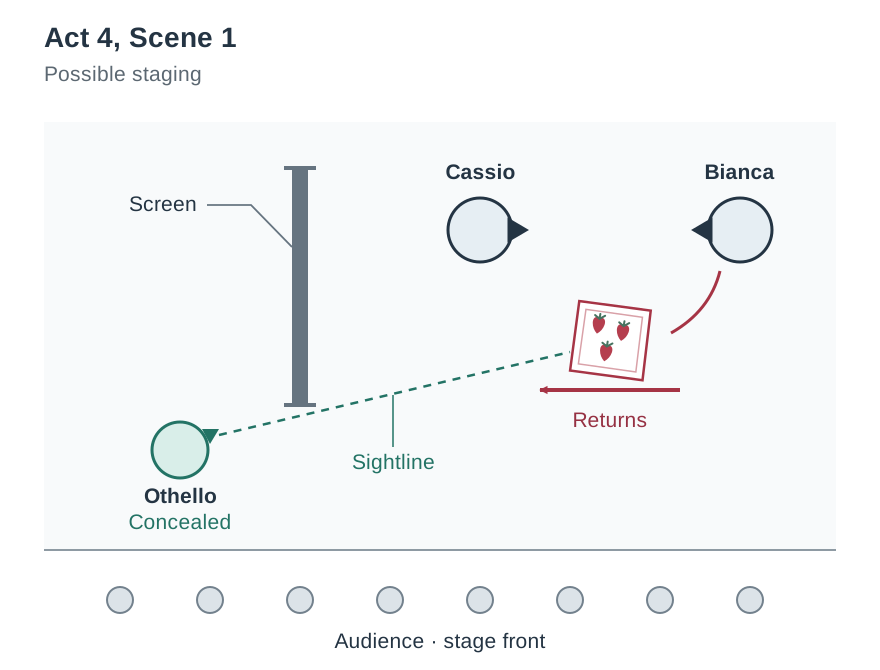
As Iago remarks, "Trifles light as air / Are to the jealous confirmations strong / As proofs of holy writ." A fragile personal object becomes lethal evidence when viewed through the lens of manufactured suspicion.
Venetian Racial Hostility and Cultural Isolation
While the Venetian state depends on Othello's military skill, its citizens harbour deep racial prejudice that leaves him isolated.
The Language of Xenophobia
In the opening scene, Iago and Roderigo incite Brabantio with bestial and dehumanising insults: "an old black ram / Is tupping your white ewe"; "your daughter and the Moor are now making the beast with two backs"; labelling Othello "the thick-lips" and a "Barbary horse". Shakespeare places this overt racism in the mouths of corrupt and self-serving characters, yet the prejudice runs throughout Venetian culture. Brabantio refuses to believe his daughter could freely choose an African general: "She is abused, stol'n from me and corrupted / By spells and medicines".
Internalised Prejudice
Because Othello is unfamiliar with Venetian social customs, Iago convinces him that Venetian women routinely conceal infidelities ("In Venice they do let heaven see the pranks / They dare not show their husbands"). Othello internalises this racial disdain, lamenting in Act 3, Scene 3:
"Haply, for I am black, / And have not those soft parts of conversation / That chamberers have... She's gone."
He eventually describes Desdemona's alleged stain using his own features: her name is now "begrimed and black / As mine own face." Societal racism penetrates Othello's psyche, causing him to view his skin as a mark of unworthiness.
Critical Perspective: Ania Loomba
Critic Ania Loomba interprets the drama as holding two tensions in balance: it represents a fantasy of interracial love and social tolerance alongside a nightmare of racial hatred and male violence. Loomba argues that a racially hostile society ultimately conditions Othello to anticipate betrayal, turning his outsider status into a fatal psychological vulnerability.
Patriarchy, Female Resistance, and Staging the Play Theatrically
The world of the play enforces strict male ownership over women's bodies and reputations.
The Silencing and Defiance of Women
Venetian patriarchy treats daughters and wives as property. In Act 1, Brabantio is woken with shouts of "Thieves, thieves!... Look to your house, your daughter, and your bags!" Desdemona's early independence gives way to confusion as Othello turns violent, yet she remains loyal to her vows.
Emilia functions as Desdemona's realistic foil. In Act 3, Scene 4, she notes how men treat women as temporary commodities: "They are all but stomachs, and we all but food; / They eat us hungerly, and when they are full / They belch us." In Act 4, Scene 3, she delivers a direct critique of male double standards, asserting that "it is their husbands' faults / If wives do fall" and insisting that "their wives have sense like them". In Act 5, Scene 2, Emilia shatters patriarchal silencing: "I will not charm my tongue; I am bound to speak." She exposes Iago's deceit, paying for her truth-telling with her life.
Approaching the Play from a Theatrical Perspective
Syllabus Learning Outcome 4.5.1 asks students to treat drama as performance rather than static text. Enhance your writing with theatrical vocabulary:
- Address the audience rather than 'the reader'. Note how Iago's downstage soliloquies pull the audience into uncomfortable intimacy, while Othello remains isolated upstage.
- Examine physical props: the handkerchief must be small enough to be passed undetected, illustrating how microscopic tokens carry monumental emotional weight.
- Comment on visual staging: in Act 4, Scene 1, Shakespeare positions Othello as a concealed eavesdropper, misreading Cassio's laughter with Bianca. In Act 5, Scene 2, the stage is dominated by the marital bed and a solitary candle, visually reinforcing the claustrophobic death of intimacy.
Key terms
- Domestic Tragedy
- A tragic drama whose catastrophe centres upon intimate personal, marital, and domestic relationships rather than broad affairs of state.
- Dramatic Irony
- A theatrical device where the audience possesses crucial knowledge of events and motives that characters on stage do not know.
- Soliloquy
- A dramatic convention where an actor delivers private thoughts aloud while alone on stage, revealing inner psychological motives directly to the audience.
- Aside
- A remark whispered by a character directly to the audience or another character that is presumed unheard by others on stage.
- Blank Verse
- Unrhymed iambic pentameter utilised by Shakespeare for aristocratic characters to signal authority, dignified stature, and composure.
- Foil
- A character placed alongside another to illuminate contrasting qualities (e.g. Emilia's cynical pragmatism contrasting with Desdemona's naive idealism).
- Ocular Proof
- Direct, visible evidence demanded by Othello in Act 3, Scene 3 to verify Desdemona's fidelity, later manufactured by Iago with the handkerchief.
- Machiavellian Villain
- An antagonist who operates by ruthless cunning, duplicity, and opportunistic manipulation to ruin rivals without moral compunction.
- Catharsis
- The release of intense pity and terror experienced by an audience at the catastrophic close of a tragedy.
- Tragic Hero
- A noble protagonist possessing exceptional stature who suffers a disastrous downfall through an error in judgement, vulnerability, or external malice.
Check yourself
What dramatic purpose is served by the destruction of the Turkish fleet at the start of Act 2?
It eliminates the external military conflict, marooning the characters in an isolated garrison where boredom and lack of purpose allow Iago's domestic manipulations to take root.
What two images does Othello use to characterise his life and actions in his final Act 5 speech?
He describes himself as 'one that loved not wisely but too well' and compares himself to the 'base Indian' who 'threw a pearl away / Richer than all his tribe'.
Which line does Emilia deliver in Act 5, Scene 2 to shatter patriarchal silencing?
'I will not charm my tongue; I am bound to speak', defying Iago's command to remain silent and exposing his guilt.
What are the three prescribed Higher Level comparative modes for the 2027 Leaving Certificate examination?
Theme or issue; Cultural Context; General Vision and Viewpoint.
How does F. R. Leavis's critical view of Othello differ from A. C. Bradley's?
Bradley views Othello as a noble, essentially blameless hero undone by superhuman villainy, while Leavis argues Othello suffers from egoism and self-delusion, making him actively complicit in his own collapse.