
Some chemical reactions do not go all the way to completion. As products form, they react together to regenerate the original reactants. In a sealed container, such a reaction reaches a point where the forward and reverse reactions proceed at the exact same rate. To an observer, the reaction appears to have stopped because the amounts of substances remain unchanged, yet at the particle level bonds are continuously forming and breaking. This state is known as dynamic chemical equilibrium. This guide covers how equilibrium is established, graphical representations of rates and concentrations, mathematical modeling of the equilibrium constant (Kc), predictions using the reaction quotient (Qc), the distinction between shifting the equilibrium position and changing Kc, Le Châtelier's principle, industrial compromise conditions, and the practical investigation of the iron(III)–thiocyanate equilibrium.
Reversible Reactions, Dynamic Equilibrium, and Rates
Many reactions go to completion—they continue until at least one reactant is completely consumed. However, in many chemical systems the products react with one another to regenerate the starting reactants. These are reversible reactions, indicated with a double equilibrium arrow ():
When carried out in a closed system (a container that allows heat to transfer in or out but prevents matter from entering or escaping), a reversible reaction eventually reaches a state of dynamic chemical equilibrium.
Why Equilibrium Happens (Collision Theory)
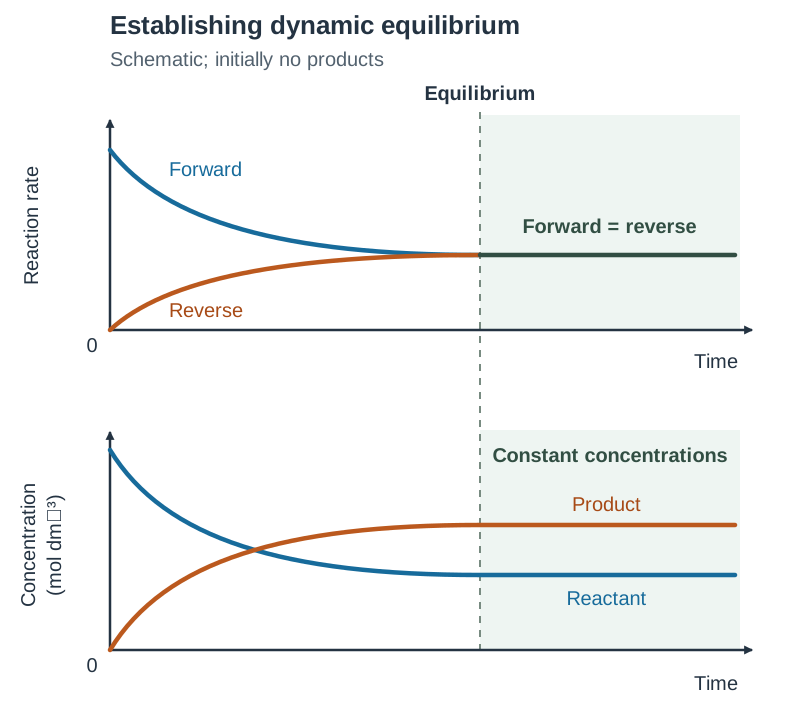
At the beginning of a reaction, the concentration of reactants is at its highest, meaning reactant particles collide most frequently and the forward rate is at its maximum. With no products present initially, the reverse reaction rate is zero. As reactants are consumed, the forward rate slows down. At the same time, product particles accumulate, collide, and react, causing the reverse rate to climb. Eventually, the forward and reverse rates become exactly equal. From that moment on, the concentrations of all reactants and products remain constant, even though reactions continue in both directions at equal speed.
Think of two escalators between two floors of a department store, one carrying people up and one carrying people down. If the exact same number of people step onto each escalator every minute, the number of people on each floor remains constant, even though individuals move continuously.
Why the System Must Be Closed
Consider the thermal decomposition of limestone:
If limestone is heated in an open vessel, the carbon dioxide gas escapes into the atmosphere. Because the cannot accumulate, product particles cannot collide to reform limestone, and the reverse rate never catches up to the forward rate. The limestone eventually decomposes completely. In a sealed, closed container, the is trapped, its concentration rises, the reverse rate increases, and equilibrium is successfully established.
Visualising Equilibrium with Graphs
Leaving Certificate examinations frequently require students to interpret or sketch two types of equilibrium graphs:
- Rate–time graph: Draw axes with time on the horizontal axis and reaction rate on the vertical axis. Start the forward curve high up on the y-axis, sloping downwards. Start the reverse curve at the origin , sloping upwards. Have the two curves merge into a single horizontal flat line. Label this plateau: Equilibrium established: forward rate = reverse rate.
- Concentration–time graph: Draw axes with time on the horizontal axis and concentration () on the vertical axis. The reactant curves decrease from initial values and flatten out horizontally. The product curves rise from the origin and flatten out horizontally. Crucially, all curves level off at the exact same time, but the horizontal plateaux do not need to be at the same height. Label the flat region: Equilibrium established: concentrations remain constant.
The Equilibrium Constant (Kc) and Reaction Quotient (Qc)
At a constant temperature, the ratio of product concentrations to reactant concentrations at equilibrium has a fixed value called the equilibrium constant (Kc).
All the Kc expressions required at Leaving Certificate are for homogeneous equilibria, where every substance in the expression is in the same physical phase — for example all gases, all dissolved in solution, or all liquids mixed together.
For a general homogeneous reaction:
The mathematical model for is:
Square brackets indicate equilibrium concentrations in . The product concentrations are multiplied in the numerator, reactant concentrations are multiplied in the denominator, and each concentration is raised to the power of its stoichiometric balancing coefficient.
Interpreting the Magnitude of
- A very large value () indicates that products predominate at equilibrium; the reaction proceeds almost to completion.
- A very small value () indicates that reactants predominate at equilibrium; very little product is formed.
- A value of close to 1 means there are appreciable amounts of both reactants and products present at equilibrium. It does not mean the individual concentrations are equal to each other.
- tells us nothing about reaction rate. A reaction with an enormous value may still proceed far too slowly to observe without a catalyst.
Predicting Reaction Direction: The Reaction Quotient ()
To determine which way an arbitrary non-equilibrium mixture will shift to reach equilibrium, calculate the reaction quotient (Qc) by substituting current concentrations into the expression:
- If : There are fewer products relative to reactants than at equilibrium. The forward reaction is favoured (shifts right) until .
- If : There are more products relative to reactants than at equilibrium. The reverse reaction is favoured (shifts left) until .
- If : The system is already at dynamic equilibrium.
Units of
Units are found by substituting into the expression and cancelling terms. If the sum of powers in the numerator equals the sum in the denominator, the units cancel out and is dimensionless. If the powers differ, leftover units must be reported (e.g., or ). Always state the units explicitly or clearly state that has no units.
Factors Affecting the Value of Kc
At Higher Level, you must clearly distinguish between factors that shift the position of equilibrium (the actual amounts of substances present) and the single factor that changes the numerical value of Kc.
Temperature is the only factor that alters the numerical value of the equilibrium constant (Kc) for a given reaction.
- Exothermic reactions (): Heat is released by the forward reaction. Increasing the temperature causes the system to absorb heat by favouring the reverse endothermic direction. As products turn back into reactants, the numerator in the expression shrinks while the denominator grows. Therefore, for an exothermic reaction, increasing temperature causes to decrease. Lowering temperature causes to increase.
- Endothermic reactions (): Heat is absorbed by the forward reaction. Increasing the temperature favours the forward reaction, generating more products. The numerator increases and the denominator decreases, so increases. Lowering temperature causes to decrease.
Why Concentration, Pressure, and Catalysts Do Not Change
- Concentration: Adding more reactant changes the individual concentrations so that the temporary ratio drops below . The system responds by converting excess reactants into products until the ratio of products to reactants returns precisely to the original value. The equilibrium position has shifted to the right, but is unchanged.
- Pressure: Compressing a gaseous mixture changes all concentrations simultaneously. The system shifts towards the side with fewer gas molecules, restoring the ratio of concentration terms so that remains constant.
- Catalysts: A catalyst lowers the activation energy equally for both forward and reverse paths. It speeds up both reactions by the exact same factor, helping the system reach equilibrium faster without altering the balance of concentrations or the value of .
Different Starting Amounts, Same
If the same reaction is carried out at the same temperature but with different initial amounts of reactants, the individual equilibrium concentrations will be different, but will have the same numerical value.
Exam justification: depends only on temperature. Changing the initial amounts changes the individual equilibrium concentrations, but the system adjusts until the ratio of product terms to reactant terms, each raised to the power of its coefficient, has the same fixed value as before.
Le Châtelier's Principle and Disturbance Predictions
Le Châtelier's principle states that if a system at equilibrium is subjected to a change in concentration, pressure or temperature, the position of equilibrium shifts in the direction that opposes (minimises) the effect of that change. Note that while this principle applies to temperature, concentration, and pressure, it does not apply to the addition of a catalyst.
How to Answer a Le Châtelier Question in Three Steps
Structure examination answers clearly using three linked points:
- State the applied disturbance (e.g., temperature increased, pressure increased, reactant added).
- State how the system responds to oppose that disturbance (e.g., shifts in the endothermic direction to absorb heat; shifts to the side with fewer moles of gas to lower pressure).
- State the observable consequence (e.g., yield of product increases/decreases, colour deepens/fades, and whether changes).
Specific Disturbances
- Concentration: Adding a substance shifts equilibrium in the direction that consumes it. Removing a substance shifts equilibrium in the direction that replaces it.
- Pressure: Applies only where gases are involved. Increasing pressure, usually by reducing container volume, shifts equilibrium towards the side with the fewer moles of gas. Decreasing pressure shifts it towards the side with more moles of gas. If the balanced equation has the same total number of moles of gas on both sides, a change in pressure has no effect on the position of equilibrium.
- Temperature: Increasing temperature shifts equilibrium in the endothermic direction to absorb heat. Decreasing temperature shifts equilibrium in the exothermic direction to release heat.
Worked Qualitative Example: Applying the Three Steps
Consider the water-gas shift reaction:
(i) What is the effect of increasing the temperature on the yield of hydrogen and on the value of ?
- Disturbance: The temperature is increased.
- Response: The system opposes the change by absorbing added heat, shifting in the endothermic (reverse) direction because the forward reaction is exothermic ( is negative).
- Consequence: The yield of hydrogen decreases, and because temperature is the only factor that alters , the value of decreases.
(ii) What is the effect of increasing the pressure?
- Disturbance: The pressure is increased (volume decreased).
- Response: The system would shift towards the side with fewer moles of gas, but here there are 2 moles of gas on the left and 2 moles of gas on the right ().
- Consequence: There is no shift in the position of equilibrium and no change in yield. remains unchanged.
(iii) What is the effect of adding a catalyst?
- A catalyst lowers the activation energy and speeds up the forward and reverse reactions equally.
- Consequence: Equilibrium is reached more quickly, but the position of equilibrium, the yield of hydrogen, and the value of are all unchanged.
Industrial Yield Optimisation and Compromise Conditions
Industrial processes must strike an economic balance between the equilibrium yield of a reaction and the rate at which product is formed, while also managing plant costs and operator safety.
The Haber Process
- Temperature: Because the forward reaction is exothermic, a low temperature favours a higher equilibrium yield of ammonia. However, at low temperatures the particles move slowly, so few collisions have enough energy to react, and the reaction is far too slow to be of any commercial use. A compromise conditions temperature of 400 °C–450 °C is used with a finely divided iron catalyst to achieve an acceptable reaction rate.
- Pressure: Four moles of gas on the reactant side produce two moles of gas on the product side (). Increasing pressure shifts the equilibrium to the right, raising ammonia yield, while also crowding gas molecules together to increase collision frequency and reaction rate. However, extreme pressures require thick-walled steel pipes, expensive pumps, and heavy electricity consumption. A compromise conditions pressure of about 200 atm balances high yield against plant construction costs and safety.
- Catalyst and Continuous Removal: A finely divided iron catalyst increases the rate of reaching equilibrium without affecting yield. Ammonia is continuously cooled, liquefied, and removed, which draws the equilibrium forward to produce more ammonia, while unreacted nitrogen and hydrogen gases are recycled.
The Contact Process
- A compromise temperature of 450 °C is used with a vanadium(V) oxide () catalyst.
- Three moles of gas become two, so higher pressure would theoretically increase the yield. However, because conversion to is already above 96% at 1–2 atm under these conditions, the marginal increase in yield is not worth the substantial cost of building and maintaining a high-pressure plant. The reaction is therefore operated at near atmospheric pressure (1–2 atm).
Investigating the Iron(III)–Thiocyanate Equilibrium
The reversible reaction between iron(III) ions and thiocyanate ions provides a clear aqueous system for observing equilibrium shifts:
Practical Laboratory Procedure
- Purpose: To observe changes in dynamic equilibrium caused by changes in concentration and temperature.
- Apparatus and Reagents: Test tubes in a test-tube rack, dropping pipettes, graduated cylinder, white tile, dilute , dilute , sodium fluoride solid () or disodium hydrogen phosphate (), ice-water bath (), and hot-water bath (approx. ).
- Method:
- Add a few drops of dilute and a few drops of dilute to about of deionised water and mix. The solution should be only a pale red-orange—dilute enough that you can easily see the colour deepen or fade when disturbed.
- Pour equal volumes (about ) into six test tubes. Keep Tube 1 as an untreated colour control.
- Add 5 drops of dilute to Tube 2.
- Add 5 drops of dilute to Tube 3.
- Add a small spatula of (or ) to Tube 4 and swirl.
- Place Tube 5 into an ice-water bath and Tube 6 into a hot-water bath near for several minutes.
- Stand all six tubes side by side in the rack on a white tile and look down through them from above, so that you are looking through the same depth of liquid in each.
Observations and Explanations
| Tube / Disturbance | Visual Observation | Chemical Explanation |
|---|---|---|
| Tube 2: Add | Colour turns deeper blood-red | Increases . The system opposes the change by shifting forward to consume the added reactant, forming more . |
| Tube 3: Add | Colour turns deeper blood-red | Increases . Equilibrium shifts forward to consume added thiocyanate. |
| Tube 4: Add or | Red colour fades to colourless or pale yellow | Fluoride ions bind tightly to to form colourless , removing free from solution. The equilibrium shifts left to replace free , decomposing . |
| Tube 5: Ice bath () | Slight change — record what you actually see (compare with Tube 1) | Record your observation. If the red colour deepens on cooling, the forward reaction is exothermic; cooling drives the system to release heat. |
| Tube 6: Hot bath () | Slight change — record what you actually see (compare with Tube 1) | Record your observation. If the red colour fades on heating, the system shifts in the endothermic (reverse) direction to absorb the added heat. State your observation first, then deduce the sign of from it. |
Note on temperature: The colour shift with temperature in this aqueous complex is much less pronounced than the dramatic change caused by concentration changes. A distinct temperature difference (ice water versus a water bath near 60 °C) and direct comparison against the untreated control tube are essential.
Experimental Evaluation and Error Analysis
- Random error: Judging colour intensity by eye varies between individuals, angles, and lighting conditions. Reduce this by comparing all tubes side by side against a clean white tile in uniform lighting, or by repeating with a second observer.
- Systematic error: Adding drops of reagent to Tubes 2 and 3 adds liquid volume, slightly diluting the mixture compared to the control tube. Reduce this by adding the same volume of deionised water to the control tube.
- Validity: Only one variable is changed per tube, with Tube 1 providing an untreated benchmark for direct comparison.
- Primary vs Secondary Data: A colorimeter can be used in school laboratories to collect quantitative absorbance data (primary data). Interactive digital simulations can also be used to explore concentration and temperature disturbances systematically (secondary data).
Key terms
- Dynamic Chemical Equilibrium
- A state in a closed system where the forward and reverse reactions proceed at equal rates, keeping the concentrations of reactants and products constant.
- Reversible Reaction
- A chemical reaction in which the products can react together to reform the original reactants, indicated by the double arrow ⇌.
- Closed System
- A physical system that permits the exchange of energy (heat) with the surroundings but prevents matter from entering or escaping.
- Equilibrium Constant (Kc)
- A constant numerical value representing the ratio of equilibrium product concentrations to reactant concentrations, each raised to the power of its stoichiometric coefficient at a specified temperature.
- Reaction Quotient (Qc)
- A ratio calculated using the equilibrium expression with current concentrations at any point during a reaction, used to predict which direction the system will shift to reach equilibrium.
- Le Châtelier's Principle
- If a system at dynamic equilibrium is subjected to a change in concentration, pressure or temperature, the position of equilibrium shifts in the direction that opposes (minimises) the effect of that change.
- Compromise Conditions
- Operational temperatures and pressures selected in industrial chemical processes to balance product yield against acceptable reaction rates, manufacturing costs, and safety.
- Homogeneous Equilibrium
- An equilibrium system in which all reactants and products are present in the same physical phase, such as all gases or all dissolved in aqueous solution.
Check yourself
What two conditions define a state of dynamic chemical equilibrium?
1. The rate of the forward reaction equals the rate of the reverse reaction. 2. The concentrations of all reactants and products remain constant in a closed system.
Which single physical factor alters the numerical value of the equilibrium constant Kc?
Temperature is the only factor that alters the numerical value of Kc.
A 1.00 dm³ flask contains 0.50 mol of H2 and 0.50 mol of I2 at a given temperature. At equilibrium, 0.78 mol of HI is present according to H2(g) + I2(g) ⇌ 2HI(g). Calculate Kc.
Change in HI = +0.78 mol, so H2 and I2 each decrease by 0.78 / 2 = 0.39 mol. Equilibrium moles: [H2] = 0.50 - 0.39 = 0.11 mol dm⁻³, [I2] = 0.11 mol dm⁻³, [HI] = 0.78 mol dm⁻³. Kc = [HI]² / ([H2][I2]) = (0.78)² / (0.11 * 0.11) = 0.6084 / 0.0121 = 50.3 (no units).
If a non-equilibrium mixture has a reaction quotient Qc that is larger than Kc, what will occur?
The system contains excess products relative to reactants; the reverse reaction will predominate (shift left) until Qc decreases to equal Kc.
Why does an increase in overall pressure have no effect on the equilibrium position of CO(g) + H2O(g) ⇌ CO2(g) + H2(g)?
Because there are equal numbers of moles of gas on both sides of the balanced equation (2 moles of gaseous reactants and 2 moles of gaseous products).
In the iron(III)–thiocyanate equilibrium, what happens visually when NaF is added, and why?
The red colour fades to colourless or pale yellow because fluoride ions bind with Fe³⁺ to form colourless [FeF6]³⁻, reducing [Fe³⁺] and pulling the equilibrium in the reverse direction.
Explain why the Haber process operates at 400 °C–450 °C rather than at room temperature.
Although the forward reaction is exothermic and low temperatures give a higher equilibrium yield, room temperature makes the reaction rate impractically slow due to low collision frequency. The moderate temperature is a compromise ensuring an economic yield at a workable speed.