

In second and third year, you study a complete film chosen from the Department of Education's prescribed list. The Junior Cycle Higher Level exam tests your ability to analyse key moments, trace character development, and explain how visual and audio techniques shape the audience's experience.
Film as a Multimodal Text
A film is a multimodal text because it combines visual images, spoken dialogue, sound effects, and music to tell a story. When analysing film, examine how dramatic choices create meaning:
- Setting: The physical place, time period, and social background that influence character behaviour.
- Plot structure: The narrative framework, moving from exposition and conflict to a climax and resolution.
- Key moment: A decisive scene that shifts the plot, exposes character motivations, or highlights a central theme.
Directors also use sound, lighting, and costume to build atmosphere. Mention these sensory elements whenever they strengthen your analysis of a scene.
Camera Shots and Angles
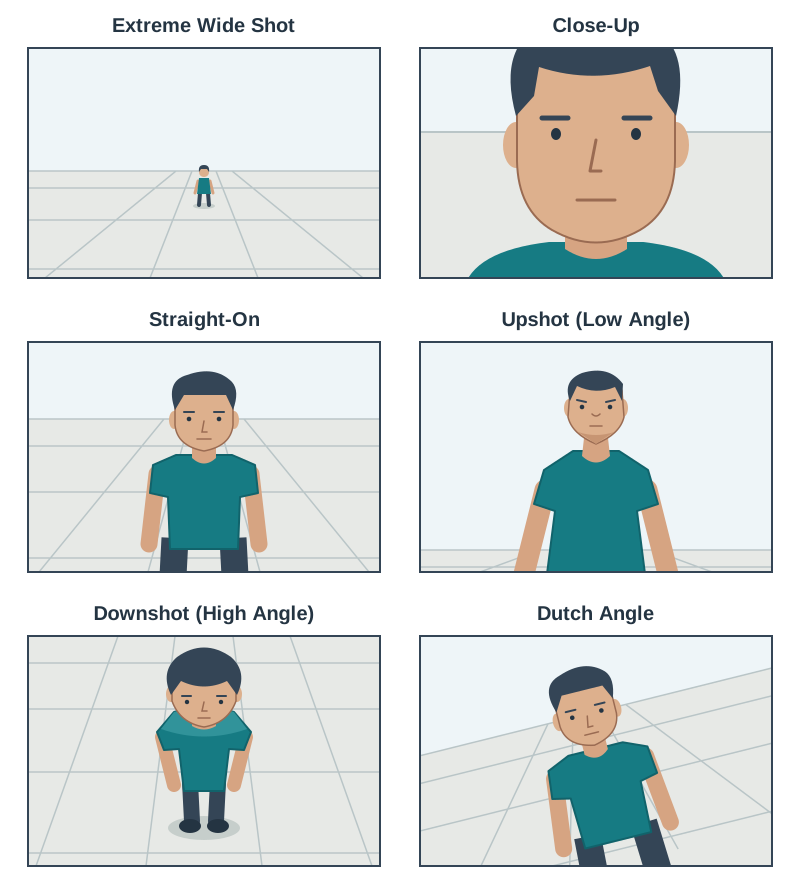
Past exam papers have used a poster to test camera choices. When analysing a camera choice, identify the shot and explain its effect in that scene.
| Shot / Angle | Framing | Possible Effect |
|---|---|---|
| Extreme Wide Shot | Vast view where subjects appear small | Can emphasise physical isolation, scale, or journey distance |
| Close-Up | Tight focus on a face or an object | Can highlight intense emotion or draw attention to a key clue |
| Straight-On | Level with the subject's eye line | Can create a balanced, neutral view of a character as an equal |
| Upshot (Low Angle) | Positioned low, looking up | Can make a figure appear dominant, menacing, or heroic |
| Downshot (High Angle) | Positioned high, looking down | Can make a subject look vulnerable, trapped, or exposed |
| Dutch Angle | Tilted off its horizontal axis | Can make a scene feel unsettling, disorienting, or tense |
Tracing Character Perspective
Exam questions often ask how a character develops or how your own perspective (opinion) of them altered over time. Character development refers to how and why a character changes, whereas your perspective is your personal evaluation, which can shift as you learn more about their true motives.
Support your analysis using three types of evidence:
- Key decisions: Crucial choices a character makes when facing conflict or moral pressure.
- Dialogue: What characters say, along with their vocal tone and shifts in language.
- Interactions: How they treat others, how relationships change, and how peers respond to them.
Comparing Film with Other Genres
The specification asks you to compare how different literary and visual genres shape meaning for an audience.
A novel can reveal thoughts through written narration. Film can use acting, camera work and sound, including voice-over: spoken narration.
When contrasting a film with a studied play or novel, point out how each medium reveals tension. A reader uses imagination to visualise descriptive prose, while a film viewer responds directly to visual framing and audio cues.
Key terms
- Multimodal Text
- A text combining two or more communication systems, such as moving images, spoken language, print, and sound.
- Setting
- The location, historical era, and social environment in which the events of a text occur.
- Key Moment
- A significant scene that alters the plot, illuminates character traits, or demonstrates a central theme.
- Close-Up
- A shot framing a face or detail tightly to draw attention to emotion or an important clue.
- Extreme Wide Shot
- A distant shot showing a vast landscape where characters appear small, highlighting setting or scale.
- Character Development
- The ways in which a character grows, alters their values, or responds to events across a narrative.
- Theme
- A central idea or underlying message explored throughout a text, such as loyalty, justice, or courage.
Check yourself
How does a film show a character's internal thoughts compared to a novel?
Novels can use written narration; films can use acting, images and sound, including spoken thoughts in voice-over.
What dramatic effect can an upshot (low angle) have in a scene?
It can make a character appear powerful, imposing, heroic, or threatening.
Can your opinion of a character change without the character changing?
Yes, because later actions and dialogue can reveal admirable or sinister motives you had not previously noticed.
What three areas of evidence should you examine when tracing character development?
Their key decisions, their dialogue, and their interactions with other characters.