

This topic covers how a business records incoming and outgoing money in an analysed cash account, posts totals into general ledger accounts, and extracts a trial balance. In the examination, you will write up these accounts from source documents, test arithmetic accuracy with a trial balance, and evaluate whether the enterprise is in a sound financial position.
The Analysed Cash Book
The analysed cash book records all money entering and leaving a business bank account, sorting amounts into columns by category.
- The debit side (Dr) records all receipts, such as capital introduced and cash sales.
- The credit side (Cr) records all payments, such as purchases, rent, and wages.
- Read the instruction above the documents: if it says 'the following payments were made', every invoice shown was paid and must be entered on the credit side.
- From a payslip, enter the Gross Pay figure in the Wages column, not the net pay.
- Money received from a debtor is entered under Bank and Debtors with no VAT, because VAT was already recorded on the invoice.
- Money paid to a creditor is entered under Bank and Creditors with no VAT.
| Dr (Receipts) | Bank | Sales | VAT | Cr (Payments) | Bank | Purchases | Rent | VAT | Wages | |
|---|---|---|---|---|---|---|---|---|---|---|
| 1 May Balance b/d | 10,000 | 9 May Purchases | 2,460 | 2,000 | 460 | |||||
| 14 May Cash sales | 4,920 | 4,000 | 920 | 24 May Rent | 800 | 800 | ||||
| 28 May Wages | 1,500 | 1,500 | ||||||||
| Total | 14,920 | 4,000 | 920 | Total | 4,760 | 2,000 | 800 | 460 | 1,500 |
Check the payments side: the analysis column totals must add up to the Bank column total (2,000 + 800 + 460 + 1,500 = 4,760). On the receipts side, the opening Balance b/d has no analysis column, so add it to the analysis totals: 10,000 + 4,000 + 920 = 14,920.
Balancing an Account
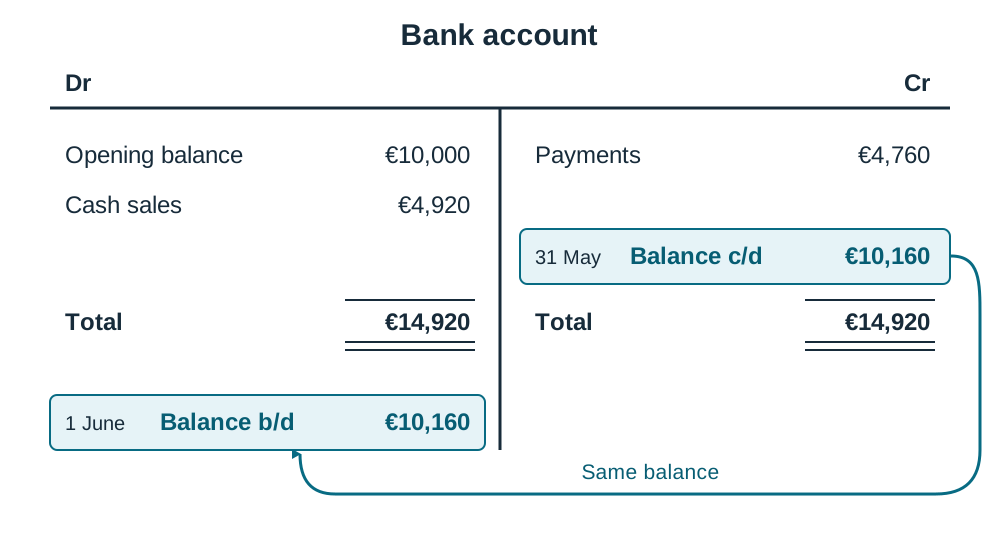
At the end of each month, total every column and calculate the closing balance for the Bank column.
Closing bank balance = opening balance + total receipts − total payments.
- Total the debit (receipts) side and the credit (payments) side separately.
- Subtract the smaller total from the larger total to find the difference.
- Enter this difference as Balance c/d (carried down) on the smaller side to make both sides balance.
- Reopen the account on the first day of the next month by entering Balance b/d (brought down) on the opposite side.
- A debit balance brought down represents an asset (cash in the bank). A credit balance brought down represents a bank overdraft, which is a liability.
- Ledger accounts are balanced the same way: total both sides, enter Balance c/d on the smaller side, and bring the balance down on the opposite side. The Balance b/d is the figure listed in the trial balance.
Posting to the General Ledger
The general ledger contains separate accounts for each category. To complete double entry, apply the opposite-sides rule on the last day of the month.
- Totals on the debit side of the cash book are posted to the credit side of general ledger accounts, such as Sales and Capital.
- Totals on the credit side of the cash book are posted to the debit side of general ledger accounts, such as Purchases, Rent, and Wages.
- Post the Debtors column total to the credit side of the Debtors account and the Creditors total to the debit side of the Creditors account.
- In the details column of each ledger entry, write Bank.
- In the VAT account, VAT on sales is credited and VAT on purchases is debited. The difference is the net VAT owed to Revenue, and this difference goes into the trial balance.
The cash book already acts as the bank account, so the Bank column total is never posted to the ledger.
Extracting the Trial Balance
A trial balance has two purposes: to check that total debits equal total credits, and to provide the list of figures used to prepare the final accounts at the end of the year.
| Trial Balance Column | Type of Accounts Included |
|---|---|
| Debit (Dr) | Assets and expenses (Bank balance b/d, Purchases, Rent, Wages, Debtors) |
| Credit (Cr) | Liabilities, income, and capital (Capital, Sales, Net VAT owed, Creditors, Overdraft) |
Always transfer the closing bank balance directly from the analysed cash book into the trial balance. Both columns must sum to the same total. Matching totals confirm double-entry equality, but they will not detect a transaction that was left out completely.
Evaluating Financial Position
Exam questions require you to interpret the completed accounts, assess financial stability, and recommend an action plan supported by figures.
- Compare total sales revenue with total running costs (purchases, rent, wages) to check if the business is trading at a profit or a deficit.
- Capital and loans put cash into the bank account but do not represent trading income.
- VAT collected on sales belongs to Revenue and is a liability, not money the business can keep.
- If asked to choose between renting or buying premises, either answer can score full marks once your reason uses figures from the accounts. For example, recommend continuing to rent because current sales cannot support monthly loan repayments, or recommend borrowing to buy because rent is a dead cost and the property becomes a fixed asset.
Key terms
- Analysed Cash Book
- A book of first entry with analysis columns used to record and classify all cash received and paid.
- General Ledger
- The book containing a separate account for each item, such as Sales, Purchases, Rent and Wages.
- Double-Entry Bookkeeping
- The accounting rule where every financial transaction is recorded with an equal debit and credit entry.
- Trial Balance
- A list of debit and credit balances extracted from all accounts to check arithmetic accuracy and prepare final accounts.
- Balance Carried Down (c/d)
- The balancing figure placed on the smaller side of an account at the end of a period.
- Balance Brought Down (b/d)
- The reopening figure placed on the true, opposite side of an account at the start of a new period.
- Capital
- The money the owner invests in the business; in a limited company this appears as Issued Share Capital.
- VAT (Value Added Tax)
- A tax on consumer spending; VAT on sales is collected for Revenue and VAT on purchases is reclaimed.
Check yourself
Where does a bank overdraft appear in the trial balance?
In the Credit column, because an overdraft is a liability owed to the bank.
When posting from the credit side of the cash book, to which side of a general ledger account does the figure go?
To the debit side, following the opposite-sides rule.
Where does a positive closing bank balance appear in the trial balance?
In the Debit column, because cash in the bank is a current asset.
Which wages figure from an employee payslip is entered into the cash book analysis column?
The Gross Pay figure.
Why is VAT received on sales not counted as trading income?
Because it is collected on behalf of Revenue and must be paid over as a liability.