

Income is the money a person receives, while expenditure is the money spent on day-to-day needs and wants. In the examination, you will classify income and spending, calculate surpluses and deficits, compute pie chart angles, and compare financial options like bank accounts or loans.
Sources of Income
Income is all the money an individual or household receives over time. We divide income into two main categories:
- Regular income: Money received on a predictable basis at set times. Examples include wages, salaries, Child Benefit, and State pensions.
- Irregular income: Money received now and again, which you cannot depend on. Examples include overtime pay, birthday gifts, sales bonuses, and lottery wins.
On a bank statement, all income appears in the payments-in or credit column. You should always plan your essential living costs around regular income because irregular income is not guaranteed.
Classifying Expenditure
Expenditure is the money spent to satisfy everyday survival needs (like food and shelter) and personal wants (like gaming consoles or holidays). Spending is sorted into three clear categories:
| Category | Meaning | Real-Life Examples |
|---|---|---|
| Fixed expenditure | A set recurring payment that does not change with usage. | Rent, mortgage repayments, motor tax, TV licence. |
| Irregular expenditure | Essential spending where the amount or timing varies based on usage. | Supermarket groceries, electricity bills, home heating oil. |
| Discretionary expenditure | Optional spending on non-essential wants after paying essential bills. | Takeaways, cinema tickets, concert passes, streaming apps. |
Some items can look like both. A gym membership is fixed in amount if paid monthly, but it is also a non-essential want. In an exam question, choose the clearest example and always state your reason.
Calculating the Financial Position
To monitor your personal finances, set out your figures in a simple table and compare total income against total expenditure:
| Item | € |
|---|---|
| Total income | 600 |
| Total expenditure | 720 |
| Net cash (deficit) | (120) |
- Surplus: Income is greater than expenditure. You have money left over to save or repay borrowings.
- Deficit: Expenditure is greater than income. You are spending more than you earn, which leads to debt.
Convert daily or weekly costs into monthly figures before calculating (for example, €5 per school day × 20 days = €100 monthly). To correct a deficit, you can either reduce expenditure (cutting discretionary items first) or increase income (such as working overtime).
Presenting Spending Data in a Pie Chart
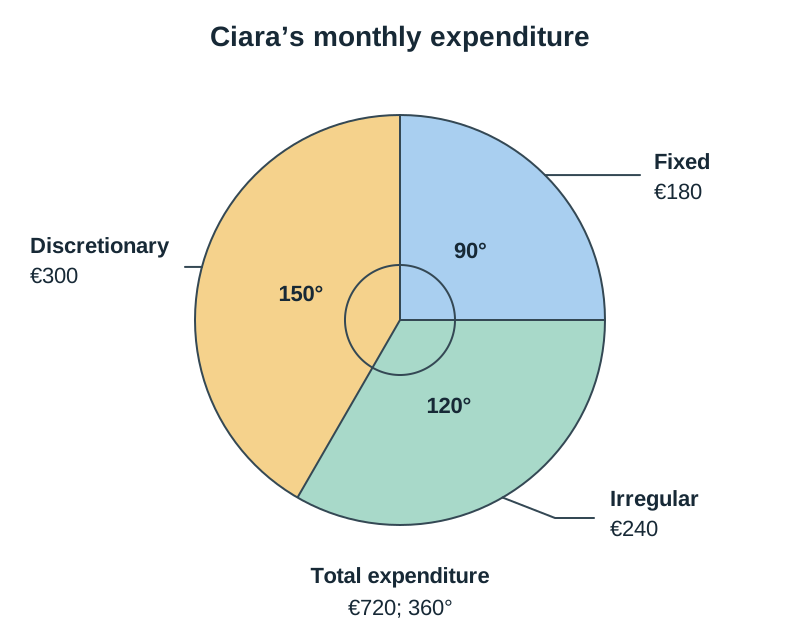
Pie charts illustrate the share of spending taken by each expenditure category. In the exam, you may need to complete a table of category totals and then calculate each sector angle:
- The bottom of the fraction is the total of whatever you are drawing — total expenditure for a spending chart, total income for an income chart. Do not mix the two.
- Calculate the degree angle for each slice and verify that all angles add up to exactly 360°.
- Draw each sector using a protractor and ruler, and label each slice with its category title and either its euro amount or percentage share.
Comparing and Managing Payment Options
Managing personal finance means selecting suitable payment methods and evaluating borrowing options:
- Standing order: An instruction to your bank to pay a fixed amount of money to a named account at set intervals, such as monthly rent.
- Direct debit: An instruction that lets a company you owe money to take different amounts from your account on agreed dates, for example an electricity bill.
- Overdraft: Permission from your bank to take more money out of your current account than you have in it, up to an agreed limit.
- APR (Annual Percentage Rate) shows the full yearly cost of borrowing, including interest and compulsory fees. The lower the APR, the cheaper the loan.
- Risks of borrowing: interest and fees make the item dearer overall, the repayment is a fixed cost every month, and missing repayments damages your credit record or can mean losing anything used as security. An overdraft is for short-term gaps only, as interest and fees apply.
When comparing two current accounts or loans, compare their fees, interest rates, and extra benefits (like cashback or banking apps). Always match your recommendation to the person's exact situation using figures from the question.
Key terms
- Regular Income
- Money received on a continuous, predictable basis at set times, such as wages or Child Benefit.
- Irregular Income
- Money received on an occasional or unpredictable basis, such as overtime, cash gifts, or bonuses.
- Fixed Expenditure
- Spending where the amount does not vary with usage and falls due at set intervals, such as a mortgage.
- Irregular Expenditure
- Spending on essentials where the timing or amount changes based on usage, like grocery or heating bills.
- Discretionary Expenditure
- Optional spending on non-essential wants rather than survival needs, such as cinema trips.
- Surplus
- A positive financial position that occurs when total income is greater than total expenditure.
- Deficit
- A negative financial position that occurs when total expenditure exceeds total income.
- APR
- Annual Percentage Rate, representing the total annual cost of borrowing money including interest and charges.
Check yourself
What type of expenditure is a €65 monthly mobile phone contract with unlimited calls?
Fixed expenditure, because the agreed bill is the same amount every month regardless of usage.
How does a standing order differ from a direct debit?
A standing order transfers a fixed sum set by the payer, while a direct debit allows a company to collect varying amounts.
If monthly income is €1,400 and total spending is €1,650, what is the financial position?
A deficit of €250 (€1,400 - €1,650 = -€250).
Account A charges a quarterly fee of €15, while Account B charges €12. Which is cheaper over one full year, and by how much?
Account B is cheaper by €12 across the year (€60 total for A versus €48 total for B).