

Written production accounts for 25% of the total marks at Leaving Certificate Higher Level (100 marks out of 400). In Section II of the written paper, correspondence is most often set as Question 2(b) for 30 marks, requiring about 75 words. Tasks alternate between formal correspondence (job applications, course enquiries, or complaints to managers) and informal correspondence (an email or letter to a French friend or host family). Letters follow a predictable physical layout, standardized openings, and set closing formulas. Learning these conventions in advance banks reliable marks before you even begin drafting the core content.
Exam Structure and Word Budget
Section II gives you choice across four questions, with Question 1 worth 40 marks (about 90 words) and Questions 2, 3, and 4 worth 30 marks each (about 75 words). The letter or email task usually appears as Question 2(b).
Budgeting Your Words
A 75-word task typically sets four or five bullet points. That leaves room for roughly one clear sentence of 12 to 15 words per bullet point, framed by your greeting and closing formula. Writing 150 words does not earn bonus marks; it increases your risk of grammatical slips and burns time needed for reading comprehensions or your opinion piece. Aim for 75 to 85 words, and ensure every single bullet point in the stimulus receives a direct, visible answer.
Visual Layout: Postal Letters versus Emails
Examiners look for standard structural features before reading your text. Presenting the correct visual skeleton signals genre awareness immediately.
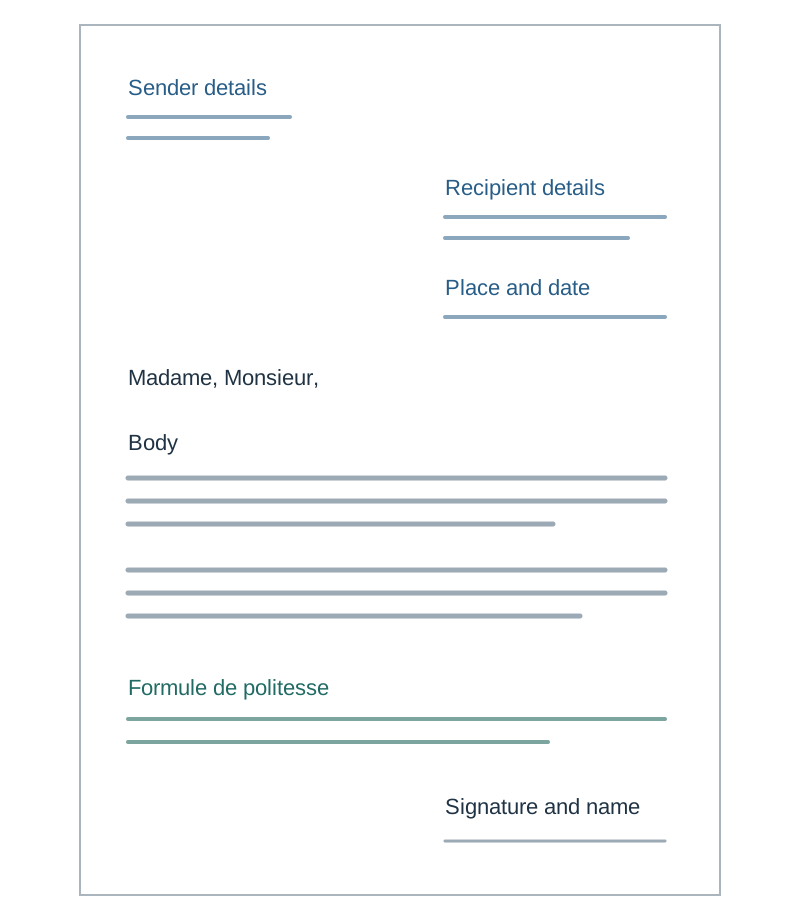
Formal Postal Letter Layout
- Top left: Sender details (e.g. Aoife Kelly, 12 Main Street, Galway).
- Top right (below sender level): Recipient title and organisation (e.g. Monsieur le Directeur, Hôtel du Parc, 75008 Paris).
- Top right (under recipient): Place and date line (e.g. Galway, le 15 juin 2027).
- Left margin: Salutation followed by a comma (Madame, Monsieur,).
- Body paragraphs: Two or three concise paragraphs answering every prompt stimulus.
- End of body: A complete formule de politesse.
- Bottom right: Signature and printed name.
In the exam hall, the place-and-date line, greeting, body, closing formula, and name are essential. Add the postal addresses whenever space permits on a written letter.
The Date Format
French date lines follow a strict order: place name, comma, definite article le, cardinal number, lowercase month, and year.
- Correct:
Cork, le 4 mai 2027 - Incorrect:
Cork, le 4ème mai 2027
French months never take a capital letter unless starting a sentence. The first day of the month is the only date written as an ordinal: le 1er juillet 2027 (le premier juillet).
Adapting for Emails (Un courrier électronique or Un mail)
When an exam prompt asks for an email rather than a postal letter, omit postal addresses and place lines. Open with a subject line at the very top: Objet : Candidature au poste de serveur or Objet : Renseignements sur le séjour. Open with Madame, Monsieur, for formal emails or Salut [Prénom] ! for friends. While Cordialement is common in everyday workplace emails, writing out a full closing formula in the exam is the safer choice: it displays command of complex grammatical structures.
Maintaining Consistent Register: Tu versus Vous
Register defines the social relationship between you and your reader. Mixing tu and vous forms within the same piece is an error examiners spot instantly, penalising both language and register marks.
| Feature | Formal Correspondence (Registre soutenu) | Informal Correspondence (Registre familier) |
|---|---|---|
| Audience | Employers, directors, managers, officials | Friends, exchange partners, host siblings |
| Pronouns | vous (both singular polite and plural) | tu (subject), te / t' (object), toi (stress) |
| Possessives | votre (singular), vos (plural) | ton, ta, tes |
| Salutation | Madame, Monsieur, or title (Monsieur le Directeur,) | Salut Nadine !, Cher Marc,, Chère Julie, |
| Closing | Fixed closing formula (Veuillez agréer...) | À bientôt,, Amitiés,, Grosses bises, |
The Salutation Rule
If you do not know the recipient's name, open with Madame, Monsieur,. If you know their professional title, use it: Monsieur le Directeur,. Cher Monsieur is only used when the writer already knows the recipient personally. In an exam letter to an employer or hotel you have never contacted before, leave Cher out—Madame, Monsieur, is always safe.
Register and Word Choice
Slang words make a formal letter sound inappropriate. Swap spoken vocabulary for written equivalents:
- Use un emploi or un poste instead of un boulot (a job).
- Use agréable or enrichissant instead of sympa or chouette (pleasant/rewarding).
- Use une voiture or un véhicule instead of une bagnole (a car).
- Use les enfants or les jeunes instead of les gosses (children).
Polite Requests: The Conditional Mood and Inverted Questions
Blunt present-tense statements like je veux (I want) or vous devez (you must) sound aggressive in French correspondence. Soften all enquiries and requests using the polite conditional (conditionnel de politesse).
Conditional Stems and Endings
The conditional uses the future stem plus imperfect endings: -ais, -ais, -ait, -ions, -iez, -aient.
| Structure | Role in Formal Letters | Example |
|---|---|---|
| Pourriez-vous... ? | Replaces pouvez-vous and je veux for all polite enquiries | Pourriez-vous me préciser les dates ? |
| Je voudrais / Je souhaiterais... | Expresses intentions or requests politely | Je souhaiterais poser ma candidature. |
| Je vous serais reconnaissant(e)... | Formal way to ask someone to review or consider a file | Je vous serais reconnaissante d'étudier mon CV. |
| Serait-il possible de... ? | Asks whether an arrangement can be made | Serait-il possible de loger sur place ? |
Asking Questions Formally
There are three ways to ask questions in French, but they carry different registers:
- Intonation only: Le logement est fourni ? (Acceptable in speech, too casual for formal writing).
- Est-ce que: Est-ce que le logement est fourni ? (Correct and neutral).
- Inversion: Le logement est-il fourni ? (The most formal, displaying high syntactic control).
To invert with a noun subject, state the noun first, then add the corresponding subject pronoun after the verb with a hyphen: Les repas sont-ils compris dans le salaire ? If the verb ends in a vowel and the pronoun starts with a vowel, insert -t-: L'hôtel offre-t-il une formation ?
The Core Vocabulary: Work and Applications
Job applications and enquiries repeat similar prompts year after year. Memorising targeted vocabulary and full sentence templates secures communication marks quickly.
Key Terms for Job Applications
- Une annonce : an advertisement
- Un poste : a position / job
- Poser sa candidature : to apply for a job
- Un entretien : an interview
- Un stage : an internship / work placement
- Le salaire : the pay / salary
- Les horaires : the hours / timetable
- L'hébergement : accommodation
- Disponible : available
- À temps partiel / À plein temps : part-time / full-time
One Learned Sentence per Bullet Point
- Age and nationality:
J'ai dix-huit ans et je suis irlandais(e). - Language level:
Je me débrouille bien en français : je l'étudie depuis six ans. - Mother tongue:
L'anglais est ma langue maternelle. - Work experience:
L'été dernier, j'ai travaillé comme serveur / vendeuse dans un supermarché. - Pay and hours:
Pourriez-vous m'indiquer le salaire mensuel ainsi que les horaires hebdomadaires ? - Accommodation:
Le logement et les repas sont-ils fournis par l'établissement ? - Availability:
Je serai entièrement disponible du 1er juillet au 25 août. - Enclosure: In a posted letter, use ci-joint (
Vous trouverez ci-joint mon curriculum vitae). In an email, use en pièce jointe (Je vous transmets mon CV en pièce jointe).
Grammatical Precision: Tense Sequencing and Connectors
Language marks reward grammatical variety and logical paragraph cohesion.
Ongoing Time: Depuis + Present Tense
When an action started in the past and continues into the present, use depuis + présent. Never use the passé composé here.
- Correct:
J'étudie le français depuis six ans.(I have been studying French for six years.) - Incorrect:
J'ai étudié le français depuis six ans.
Sequencing Time Clauses
- Avant de + infinitive (used when both clauses share the same subject): Avant de réserver, j'ai lu les avis en ligne. (Before booking, I read the reviews online.)
- Avant que + subjunctive (used when the subject changes): Je vous écris avant que la saison ne commence. (I am writing to you before the season begins.)
- Après avoir / être + past participle (actions completed before another): Après avoir terminé mes examens, je serai libre. (After finishing my exams, I will be free.) Remember agreement with être: Après être rentrée en Irlande, j'ai commencé mon stage.
- En + present participle (simultaneous actions or method): J'ai perfectionné mon niveau en travaillant dans un restaurant. (I improved my level by working in a restaurant.)
Linking Words for Cohesion
Use two or three linking words to connect your sentences smoothly:
- Ordering: d'abord (first of all), ensuite (then), enfin (finally).
- Adding: de plus (moreover), en outre (furthermore).
- Contrast: cependant / toutefois (however), par contre (on the other hand), d'un côté... de l'autre (on the one hand... on the other).
- Reason and Result: par conséquent (consequently), c'est pourquoi (that is why), étant donné que (given that).
Closing Formulas: Les Formules de Politesse
Learn your chosen formal closing formula off by heart and write it out word for word; do not attempt to build your own version under exam conditions.
Echoing the Greeting
The closing formula must repeat the greeting you used at the top:
- If you opened with Madame, Monsieur,:
Dans l'attente de votre réponse, je vous prie d'agréer, Madame, Monsieur, l'expression de mes salutations distinguées. Alternative: Veuillez agréer, Madame, Monsieur, l'assurance de ma considération distinguée.
- If you addressed an official by title (Monsieur le Directeur,):
Veuillez agréer, Monsieur le Directeur, l'expression de mes salutations distinguées.
Formula Rules
- Direct object construction: The verb agréer takes a direct object without a preposition. Write
agréer l'expression, neveragréer à l'expression. - Accepted variants: In the Leaving Certificate, formulas ending in mes salutations distinguées, mes sentiments distingués, or ma considération distinguée are all fully accepted. Pick one formula, memorise it accurately, and match the greeting exactly.
Informal Correspondence and Checking Routine
When writing to a French friend, pen-pal, or exchange partner, switch entirely to the informal register (registre familier).
Structure of an Informal Email to a Friend
The exam prompt typically provides an email from a friend containing three or four questions. Communication marks are allocated question by question, so answer every question in the stimulus in the order it was asked, and include one question back to the friend at the end.
- Objet : Nouvelles d'Irlande or Mon choix de carrière
- Greeting: Salut Nadine ! or Chère Julie,
- Opening line: Merci pour ton mail, ça m'a fait très plaisir d'avoir de tes nouvelles ! (Thanks for your email, it was great to hear from you!)
- Body: Answer each question clearly, using tu / ton / ta / tes.
- Sign-off: À bientôt,, Amitiés,, or Grosses bises,, followed by your first name.
90-Second Exam Checking Routine
- Check bullets: Count the bullet points in the prompt and ensure each one has a visible answer.
- Check register: Scan all verbs and pronouns. Confirm they are strictly vous / votre (formal) or tu / ton (informal)—never a mixture.
- Check first-person agreements: If you are writing as a female student, check adjectives and participles referring to yourself (je suis irlandaise, je suis déçue, je vous serais reconnaissante, je suis rentrée).
- Check crucial accents: Ensure you have included é on past participles (travaillé, étudié), the grave accent on à (à bientôt), and the cedilla on ça.
- Check the formula echo: Verify that the vocative inside your closing formula (Madame, Monsieur,) matches your opening greeting word for word.
Key terms
- Madame, Monsieur,
- The standard formal salutation in French official letters and business correspondence, equivalent to 'Dear Sir or Madam'. It is never preceded by 'Cher'.
- Formule de politesse
- The mandatory formal closing sentence placed before the signature in French correspondence (e.g. 'Veuillez agréer, Madame, Monsieur, l'expression de mes salutations distinguées').
- Conditionnel de politesse
- The use of conditional verb forms (such as 'pourriez-vous' or 'je souhaiterais') to frame requests courteously rather than making blunt present-tense demands.
- Poser sa candidature
- The set French idiom meaning to apply for a job, post, or work placement ('poser ma candidature au poste de...').
- Ci-joint / En pièce jointe
- 'Ci-joint' denotes an enclosure inside a physical postal letter; 'en pièce jointe' denotes an email attachment.
- Depuis + présent
- The grammatical construction used to describe an action that started in the past and continues in the present ('J'étudie le français depuis six ans').
- Objet :
- The subject header placed at the top of an email or administrative letter outlining the purpose of writing.
- Amitiés
- An informal sign-off meaning 'Best wishes' or 'Warm regards', used exclusively in personal correspondence with friends or acquaintances.
Check yourself
What is the correct French date line for a letter written in Galway on the first day of June 2027?
Galway, le 1er juin 2027 (cardinal numbers are used for all days except the first, which uses 'le 1er', and months are lowercase).
Your formal letter begins with the greeting 'Monsieur le Directeur,'. Write a complete matching closing formula.
Veuillez agréer, Monsieur le Directeur, l'expression de mes salutations distinguées. (or: '...l'assurance de ma considération distinguée.').
How do you turn 'Est-ce que le logement est fourni ?' into a formal inverted question?
Le logement est-il fourni ? (Noun subject first, followed by verb-pronoun inversion with a hyphen).
Translate into French: 'I have been studying French for six years.'
J'étudie le français depuis six ans. (Present tense + depuis).
When sequencing two events in the past with different subjects, do you use 'avant de' or 'avant que'?
Use 'avant que' followed by the subjunctive (e.g. 'avant que la saison ne commence'). 'Avant de' + infinitive can only be used when both clauses share the same subject.
What two layout elements distinguish a formal email header from a formal postal letter?
An email opens with an 'Objet :' (subject) line at the top and omits physical postal addresses and place-and-date lines.