

Personal, digital, and broadcast media composition requires you to shape voice, register, and tone across four common media forms: personal diaries, online blogs, radio talks or interviews, and podcast scripts. The Leaving Certificate English syllabus classifies language into five core functions: information, argument, persuasion, narration, and aesthetic use. Modern media compositions blend these functions naturally. A personal blog might inform readers about an issue, narrate a personal incident, and persuade readers to reflect on their own habits. In Paper 1, whether you are tackling a 50-mark Question B functional task or a 100-mark Section II composition, marks depend on an authentic voice suited to the audience, complete coverage of the task, and sustained control under the State Examinations Commission PCLM criteria. As a practical timing guide, aim to spend roughly 35 to 40 minutes on Question B and 75 to 80 minutes on the Section II composition.
The Core Assessment Framework: PCLM and Task Planning
Every composition in Leaving Certificate English is evaluated against four criteria established by the State Examinations Commission:
- Clarity of purpose (30%): Engaging directly with the prompt, adopting the correct register for the stated speaker and audience, and covering every bullet point or requirement in the task.
- Coherence of delivery (30%): Structuring the piece with logical transitions, sustained momentum, and a shape that feels complete, with a clear opening and a satisfying ending rather than one that just stops.
- Efficiency of language use (30%): Crafting vivid, precise, and expressive prose suited to the medium. Digital and broadcast tasks usually call for a spoken, engaging voice, informal for a personal blog or podcast and more measured for a serious radio talk. Always match the register to the audience named in the task.
- Accuracy of mechanics (10%): Maintaining standard spelling, punctuation, grammar, and sentence structure.
Covering Every Bullet Point
Question B tasks usually specify three things: who you are, who is listening or reading, and what you must do. Before writing, underline each prompt in the question and allocate it a paragraph or section in your plan. If a prompt asks for tactical advice, an opponent review, and a motivational closing, leaving out any one of those three limits your mark for clarity of purpose, which drags down the rest of your grade.
The Personal Diary: Introspection and Emotional Truth
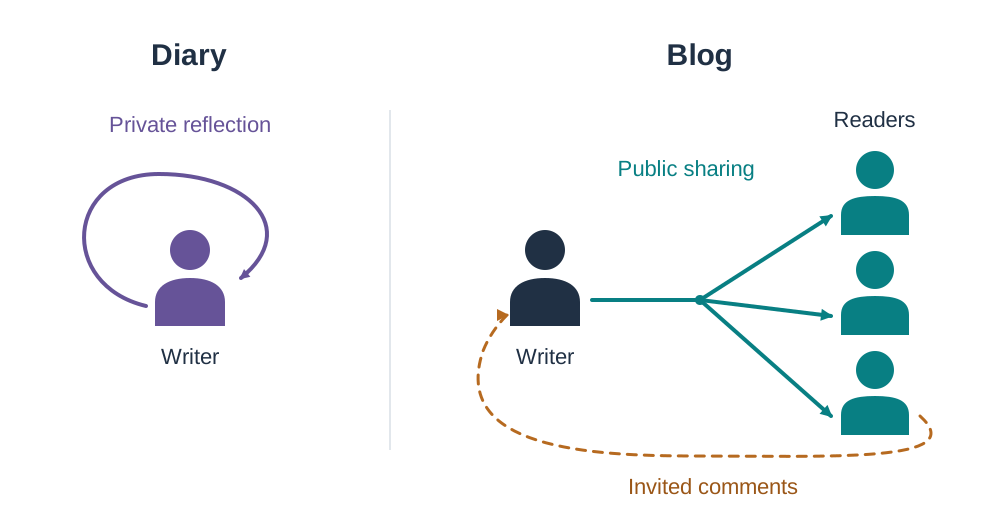
A diary entry is private writing meant solely for the writer, or an imagined persona. Because it is not written for an external public audience, its register relies on emotional vulnerability, interior monologue, and uninhibited candour.
Practical Diary Conventions
- Open with the date at the top of the page, for example Thursday, 14th November, and add the time or place if you wish, such as 11:15 pm, kitchen table. After that, move straight into the writer's thoughts.
- You can open with a greeting like Dear Diary or dive directly into your thoughts. Both approaches work well.
- Selective focus: Develop two or three important moments or changes in feeling instead of listing everything that happened that day.
- Avoid formal correspondence endings like Yours sincerely. Conclude on an unresolved question, a quiet realisation, or a thought about tomorrow.
- Exam questions sometimes ask you to write as a specific character or to compose a sequence of two or three entries. When writing a series, make sure each entry shows a clear change in thought, mood, or circumstance so the response develops rather than repeats itself.
Style and Interiority
Informality in a diary comes from psychological honesty, varied sentence rhythms, and sensory details, never from text-speak or lazy grammar. Use dashes and occasional ellipses to capture half-formed realisations.
The Blog Post: Public Digital Voice and Useful Conventions
A blog post bridges personal reflection and public discussion. It addresses an active online readership, balancing individual personality with ideas the audience can relate to.
Useful Blog Conventions
A short headline and one or two light touches are enough to signal the form. Purpose marks come from sustaining the right voice for the stated audience and dealing fully with every part of the task throughout the answer, not from elaborate layout.
- Provide a punchy headline that sets up the topic.
- You may include a brief web address banner, pseudonym, and date at the top, but do not waste time drawing complex page designs.
- Drop in a bracketed hyperlink reference, for example [read my earlier piece on morning routines here], to give the feel of online publishing.
- End with a call to action, such as a direct question inviting readers to share their views in the comments section.
Voice and Balance
A blog should not read like a formal academic essay. Write in the first person, address your readers directly using 'you' and 'we', and use humour or self-deprecation to make your points memorable.
The Radio Talk and Broadcast Interview: Spoken Register and Interaction
Radio scripts are written for the ear. They rely on verbal rhythm, clear sentence structures, and audible signposts so listeners can follow spoken ideas without needing to reread.
The Single-Speaker Radio Talk
Open with a brief greeting that introduces who you are, the programme name, and your topic. Use verbal signposts such as 'My second point is simple' or 'Let me take you back three years' to mark out stages in your talk. Sentences should sound natural when read out loud, mixing short emphatic statements with longer explanatory ones.
The Two-Speaker Broadcast Interview
Set the broadcast context briefly with bracketed sound cues if needed, such as [theme music fades]. Identify speakers clearly on each new line using speaker tags.
| Speaker | Typical Role & Register | Balance of Talk |
|---|---|---|
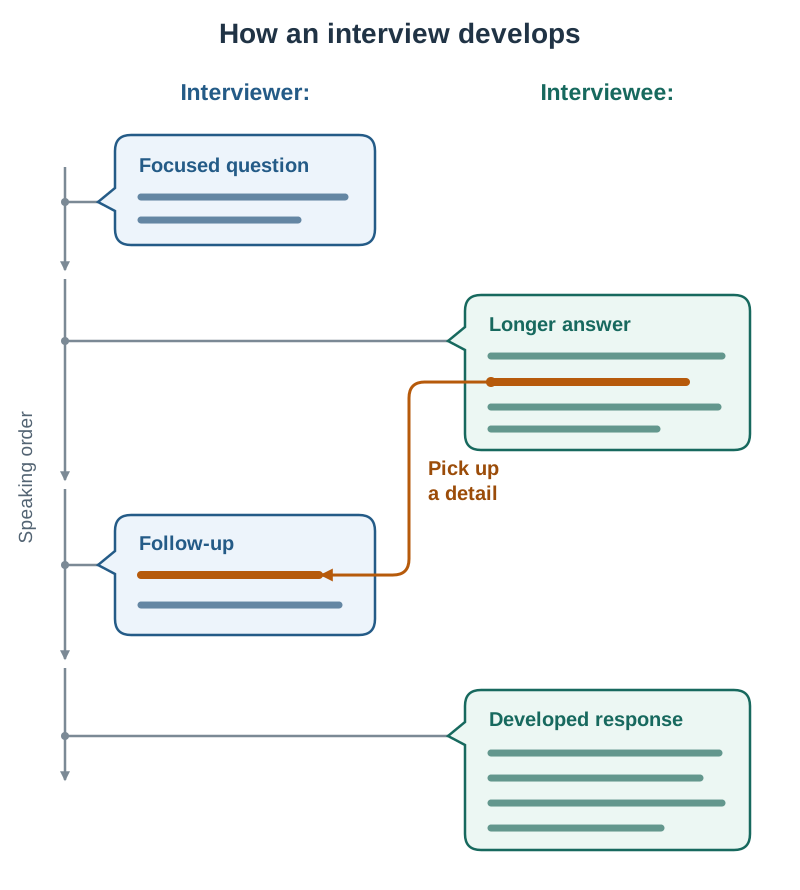
| Interviewer | Guides the discussion, listens actively, sets context, and follows up | Keeps questions focused and purposeful; questions can be one or two sentences, with longer turns to challenge or set context |
| Interviewee | Provides personal stories, expert insights, and reflective depth | Does most of the talking; uses developed paragraphs with anecdotes and personal opinion |
The host must react naturally to what the guest just said before moving to the next question. Avoid turning the script into a mechanical question-and-answer list.
The Podcast Script: Intimate Conversational Storytelling
Podcasts often feel more personal than radio: the listener chooses the show and usually hears it alone on earphones, so the host can talk as if to one friend.
Podcast Framework
- The Hook and Welcome: Greet your listeners, name the show, and draw them in with a curious question or a relatable, mildly chaotic dilemma.
- The Conversational Core: Work through two or three focused segments. Move between personal stories, cultural references, and thoughtful reflections using smooth bridges like 'That brings me to the strangest part of this whole business...'.
- The Outro: Pull your thoughts together, leave listeners with a memorable idea, invite them to subscribe or leave a comment, and close with a consistent sign-off phrase.
The techniques taught for blogs and talks, such as anecdote, direct address, humour and rhetorical questions, work in podcasts too. Choose the mix that suits your audience, and keep a natural spoken rhythm.
Reading Personal Media Writing: Question A Stylistic Features
The techniques you practise when composing personal media are the exact features Question A asks you to identify and evaluate in Comprehending texts. Past exams frequently ask students to discuss four stylistic features that make a personal essay, memoir extract, or media article engaging.
Key Stylistic Features to Identify
- Authentic personal voice: The writer establishes an unmistakable, credible personality from the outset.
- Anecdote: A short, concrete personal story used to illuminate a wider truth.
- Tonal variety: Shifting between humorous, reflective, confessional, and earnest registers.
- Self-characterisation: The writer depicts themselves as a distinct, sometimes flawed or humorous character.
- Vivid imagery: Fresh similes, metaphors, and sensory details that make experiences tangible.
- Varied sentence length: Short, punchy sentences for dramatic emphasis set against longer, reflective sentences.
- Direct address and inclusive language: Using 'you' and 'we' to build rapport with the reader.
Why Personal Writing Appeals
When asked to explain the enduring appeal of personal writing such as memoirs and diaries, build your answer around three distinct points:
- The first-person voice creates an immediate human connection, allowing readers to share another person's private thoughts.
- True-life stories offer realistic grounding that appeals to readers who prefer non-fiction over invented plots.
- Insider accounts satisfy natural curiosity about worlds, eras, or professions readers could not otherwise experience.
Key terms
- Clarity of purpose
- The PCLM criterion (30%) assessing how well an answer addresses the set task, sustains the correct genre conventions, and writes for the specified audience.
- Coherence of delivery
- The PCLM criterion (30%) evaluating structure, paragraph development, smooth transitions, and overall organisation.
- Efficiency of language use
- The PCLM criterion (30%) assessing the quality, precision, tone, vocabulary, and stylistic control of the writing.
- Accuracy of mechanics
- The PCLM criterion (10%) evaluating standard spelling, punctuation, grammar, and sentence syntax.
- Register
- The tone, vocabulary, and grammatical choices adopted to suit a specific medium, speaker, and target audience.
- Verbal signposts
- Phrases in a spoken script that orient the listener and show where the talk is heading, such as 'Let us look at the real issue' or 'Turning to my second point'.
- Speaker tags
- Labels placed at the start of a line in an interview or dialogue script to indicate who is speaking, such as Host: or Sarah:.
- Call to action
- A closing appeal in digital or persuasive media encouraging the reader or listener to respond, comment, reflect, or take a specific step.
- Direct address
- Speaking directly to the audience using second-person pronouns like 'you' and 'your' to establish immediate rapport.
- Anecdote
- A short, vivid personal story used within a talk, blog, or essay to illustrate a broader idea or build a human connection.
Check yourself
What are the four criteria of the State Examinations Commission PCLM assessment framework, including their percentage weightings?
Clarity of purpose (30%), Coherence of delivery (30%), Efficiency of language use (30%), and Accuracy of mechanics (10%).
What details should you provide at the top of a diary entry before beginning the text?
The date (including the day of the week if you wish), and optionally the time or location of writing, after which you proceed directly into the writer's thoughts.
Why should an interviewer's speaking turns generally be shorter than an interviewee's in a broadcast script?
The interviewer's role is to steer the discussion, set context, and prompt the guest, while the interviewee is the focus of the piece and supplies the detailed stories, arguments, and insights.
Identify two stylistic features evident in the blog worked example that make it engaging personal writing, citing a brief quotation for each.
Metaphor: 'anonymity is your protective armour', which gives concrete weight to a feeling; and Humour: the crow 'shouting aggressively at the fog', which adds a light, comic touch through personification.
Explain two reasons why personal writing genres like memoirs and diaries have wide and enduring appeal for readers.
They provide an authentic human connection through the first-person voice, and their true-life realism satisfies curiosity about experiences and worlds that fiction cannot always match.