

The listening section tests your understanding of spoken French on familiar topics such as daily routines, hobbies, school, and travel. You will identify the general topic and extract specific factual details from dialogues, interviews, and everyday conversations.
Understanding Spoken Conversations
Conversations on the paper feature two or more speakers exchanging information, asking for directions, or conducting an interview. You do not need to understand every single word to answer correctly.
Follow each question's instructions: tick an option, complete a number, or write an answer in the language requested.
- Read the questions before the audio plays and underline question words to identify what fact is needed.
- Use the first listening to grasp the general topic and catch obvious details.
- Use subsequent listenings to confirm exact information and check for qualifying words.
- Give two different facts when asked for two details. Repeating one fact does not supply the second answer.
- If a speaker corrects a detail during natural speech, use the corrected information when it answers the question.
Question Words and Direction Cues
An interviewer's question helps you predict the answer. Keep listening for the relevant detail.
- Qui ? / Avec qui ?: signals a person, friend, or relative.
- Où ?: signals a location, town, or building.
- Quand ? / À quelle heure ?: signals a day, date, or specific clock time.
- Pourquoi ? means “why?” Listen for the reason; parce que means “because”.
- Combien ?: signals a number, price, or quantity.
Directions often feature in conversations where someone asks for help:
- Où se trouve... ? or Pour aller à... ?: asking where a place is or how to get there.
- Tournez à gauche / à droite: turn left / right.
- Continuez tout droit: go straight on.
- La première / deuxième rue: the first / second street.
- En face de / à côté de / près de: opposite / beside / near.
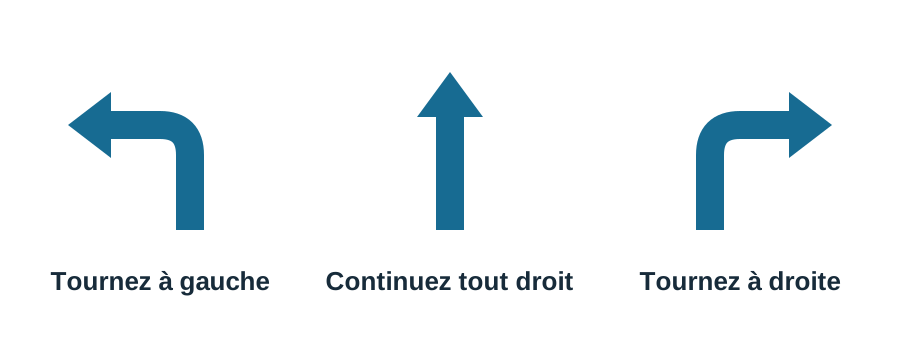
Destination and directions are usually separate questions, so identify both the specific landmark and the movement.
Marker Words and Opinion Signposts
Marker words act like road signs. They connect ideas and indicate why someone says something or when their opinion changes.
- Parce que (because): signals an explanation or reason for an opinion or choice.
- Mais / Par contre (but / on the other hand): signals a contrast or change of preference.
- Donc: means 'so' or 'therefore' and introduces a result or conclusion.
- D'abord / Puis / Enfin: sets out a chronological sequence of events.
Pay close attention to whether an opinion is positive (j'adore, passionnant, c'est super) or negative (je déteste, ennuyeux, c'est nul), as a single adjective often answers why an activity is liked or disliked.
Times, Numbers, and Negation Traps
Details such as numbers, schedules, and routines must be noted accurately.
- Habitual versus specific days: samedi usually means 'on Saturday', whereas le samedi usually means 'on Saturdays' (a recurring routine).
- Duration versus time: distinguish between a duration like pendant deux heures (for two hours) and a specific clock time like à deux heures (at two o'clock).
- Units: Keep quantities precise and include the unit unless the answer space already supplies it.
- Negation: listen carefully past the verb. A statement reverses completely when you hear ne ... pas (not) or ne ... plus (no longer). In fast speech, ne is often dropped, so listen closely for pas and plus.
Key terms
- Gist
- The main topic or overall meaning of a conversation.
- Specific detail
- An exact piece of factual information, such as an age, place, time, or quantity.
- Question word
- A spoken prompt such as où, quand, or pourquoi signalling the category of information that follows.
- Marker word
- A connective such as parce que, mais, or donc that signals reasons, contrasts, or results.
- Negation
- Language expressing a negative meaning; in speech, ne is often omitted, so listen for pas or plus.
- Habitual marker
- Le before a weekday usually indicates a recurring routine.
Check yourself
In the sentence 'Je ne joue plus au tennis', does the speaker still play tennis?
No; they no longer play.
What is the difference in meaning between 'samedi' and 'le samedi'?
Samedi usually means “on Saturday”; le samedi usually means “on Saturdays”.
If a tourist asks 'Pour aller à la gare ?' and hears 'Prenez la deuxième rue à droite', what should you note for the destination and direction?
Destination: the station; Direction: take the second street on the right.
Which marker word signals that a speaker is about to give a reason for an action or opinion?
Parce que (because).