

Cell membranes are selectively permeable barriers that regulate the movement of substances into and out of cells to keep internal conditions steady. Movement across membranes happens by passive mechanisms like diffusion and osmosis, which need no cellular energy, and active mechanisms like active transport, which consume ATP. This topic covers the fluid mosaic model of membrane structure, how osmosis affects animal and plant cells, practical applications in food preservation and plant support, and the laboratory investigation of how concentration gradient, temperature, and surface area affect the rate of osmosis.
Membrane Structure and Functions
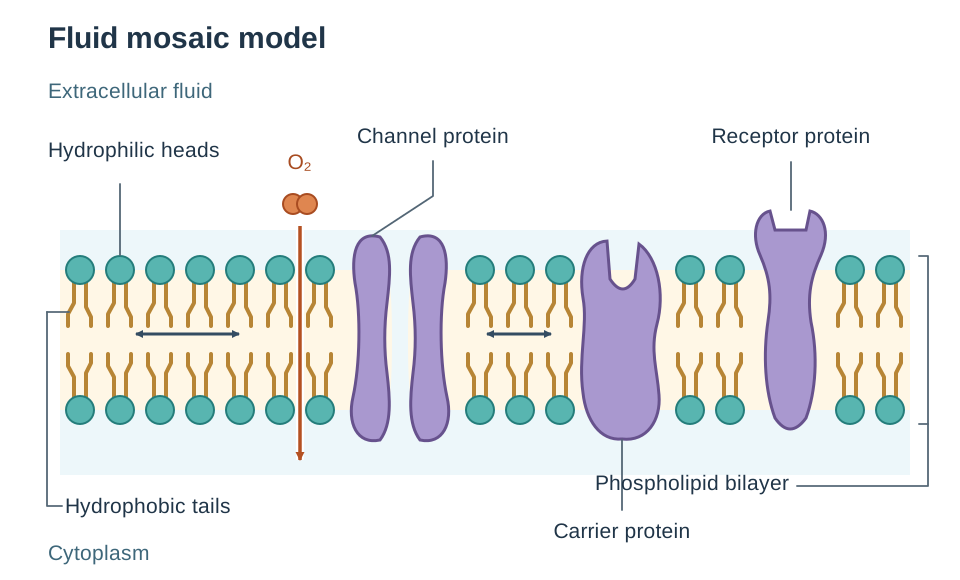
Every living cell is enclosed by a cell membrane, also known as the plasma membrane. We describe its structure using the fluid mosaic model. This model pictures the membrane as a flexible double layer of lipids with proteins dotted throughout.
Main Functions
- It is selectively permeable, controlling which molecules enter and leave.
- It holds the cell contents together, separating the cytoplasm from the external environment.
- It anchors receptor proteins that recognise chemical signals like hormones, alongside channel and carrier proteins that transport substances across.
Membrane Components
- Phospholipid bilayer: A double sheet of phospholipids forms the core framework. Each phospholipid molecule has a polar phosphate head that is hydrophilic (water-loving) and faces outward towards water inside and outside the cell. It also has two non-polar fatty acid tails that are hydrophobic (water-hating) and point inward away from water.
- Membrane proteins: Proteins float within the bilayer like tiles in a mosaic pattern. Some form pore-like channel proteins that let ions and polar molecules slip across. Others work as carrier proteins that bind specific nutrients and change shape to carry them through. Water passes directly through the bilayer, and much of it moves through dedicated protein channels.
- Membrane fluidity: The bilayer is not a rigid sheet. Phospholipids and proteins drift sideways within their layer, letting the cell alter its shape and mend small tears.
Small non-polar molecules like oxygen () and carbon dioxide () dissolve straight through the hydrophobic core of the bilayer down their concentration gradient. By contrast, large polar molecules and charged ions need transport proteins to cross.
Comparing Diffusion, Osmosis, and Active Transport
Substances move across cell membranes through three main processes. You need to distinguish them clearly based on energy needs, direction of travel, and whether a membrane is required.
| Feature | Diffusion | Osmosis | Active Transport |
|---|---|---|---|
| What moves | Any gas, liquid, or dissolved solute particles (such as or ) | Water molecules only | Solute molecules or ions (such as nitrates or glucose) |
| Direction | Down a concentration gradient (high to low concentration) | Down a water concentration gradient (high to low water concentration) | Against a concentration gradient (low to high concentration) |
| Membrane needed? | No membrane required | Yes, needs a selectively or semi-permeable membrane | Yes, needs a living membrane with carrier proteins |
| Energy needed? | Passive (no ATP needed) | Passive (no ATP needed) | Active (requires energy from ATP) |
| Biological example | diffusing from lung alveoli into red blood cells | Water entering root hair cells from soil water | Mineral ions () pumped into plant roots |
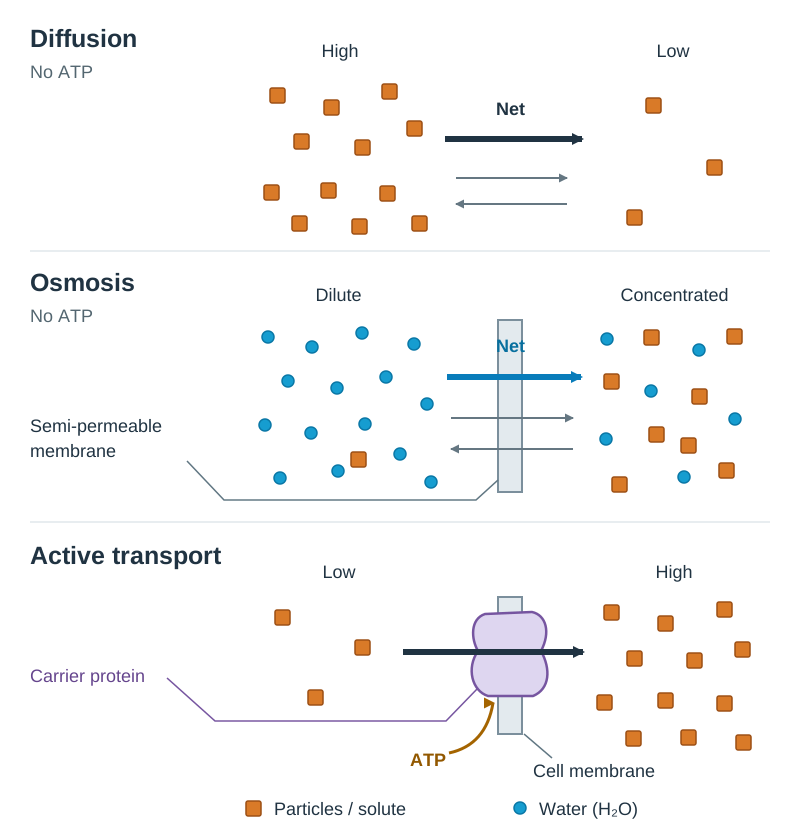
Think of osmosis as a special case of diffusion. It is simply the diffusion of water molecules across a selectively or semi-permeable membrane.
Principles of Osmosis
Osmosis is the movement of water molecules from a region of high water concentration to a region of low water concentration across a semi-permeable (or selectively permeable) membrane.
To talk about osmosis without getting confused, keep your solution terms straight:
- Solute: The substance dissolved in a liquid (like table salt or sucrose).
- Solvent: The liquid that does the dissolving (water is the main solvent in biology).
- Solution: The mixture formed when a solute dissolves in a solvent.
A dilute solution contains very few solute particles, which means it has a high water concentration. A concentrated solution contains lots of dissolved solute, meaning its water concentration is low. Water moves down its own concentration gradient, travelling from a dilute solution towards a more concentrated one across the membrane until concentrations balance out.
In school experiments, dialysis tubing (Visking tubing) acts as a semi-permeable membrane. Its tiny physical pores let small water molecules pass while holding back larger solute molecules like sucrose. Real cell membranes are selectively permeable: their proteins control which substances can pass through.
Osmosis in Animal and Plant Cells
Animal cells have only a flexible cell membrane, whereas plant cells have a rigid outer cell wall made of cellulose. The plant cell wall is fully permeable to water and dissolved minerals, while the inner cell membrane is selectively permeable. Because of this structural difference, plant and animal cells behave quite differently when external water levels change.
| External Solution | Animal Cell (e.g. Red Blood Cell) | Plant Cell (e.g. Potato or Onion Cell) |
|---|---|---|
| Hypotonic (more dilute / higher water than cell contents) | Water enters by osmosis. The cell swells and bursts (lysis) because it has no cell wall to resist the pressure. | Water enters the vacuole and cytoplasm by osmosis. The cell swells until it pushes firmly against the wall. It becomes turgid. Turgor pressure prevents extra water entering and stops the cell bursting. |
| Isotonic (equal water and solute concentration to cell contents) | Water moves in and out at equal rates. No net change in volume occurs. | Water moves in and out at equal rates. The cell is flaccid because the cytoplasm does not press against the cell wall. A plant in this state will wilt. |
| Hypertonic (more concentrated / lower water than cell contents) | Water leaves by osmosis. The cell shrinks and develops a notched, crinkled edge (crenation). | Water leaves by osmosis. The cell loses turgor and becomes flaccid, and then the cytoplasm pulls completely away from the cell wall. The cell is plasmolysed. |
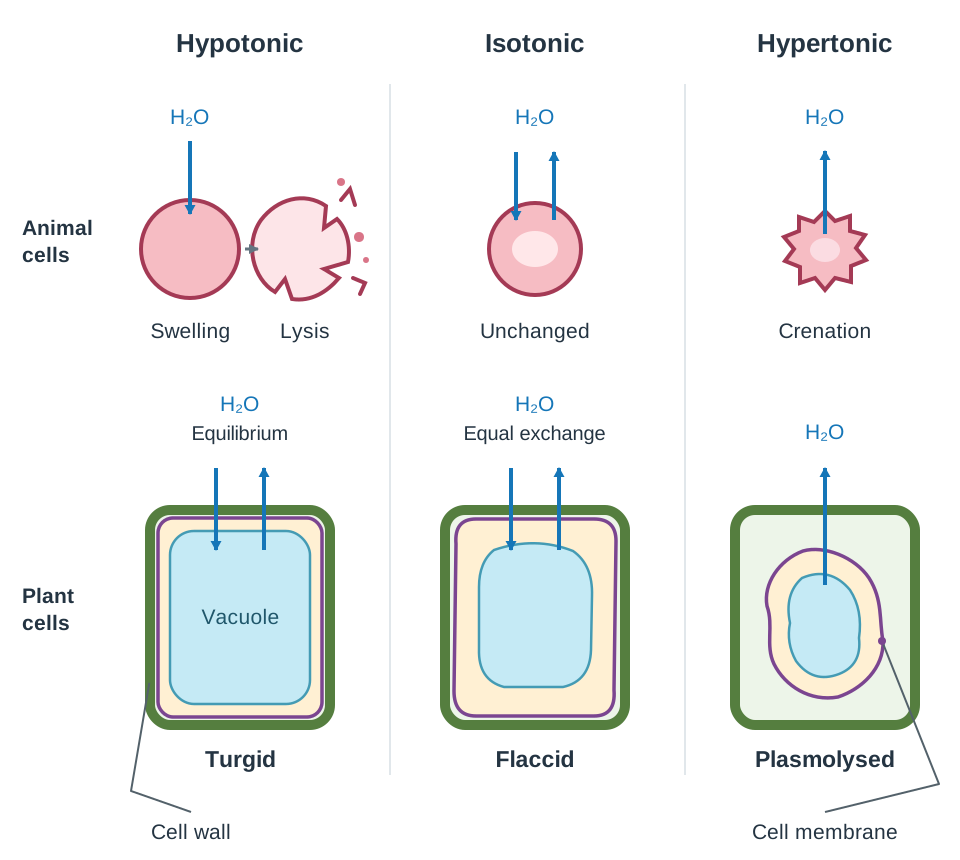
Turgor pressure is the outward push of the swollen vacuole and cytoplasm against the plant cell wall. This mechanical pressure is what keeps young stems, leaves, and flowers standing upright.
Applications: Plant Health and Food Preservation
Osmosis plays a direct part in everyday plant physiology and gives us a simple way to preserve food without adding poisons.
Osmosis in Plant Health
- Root absorption: Soil water is normally more dilute than the sap inside root hair cells. Water moves into root hairs by osmosis, creating root pressure and keeping the plant hydrated.
- Plant support and fertiliser scorch: Turgor pressure holds stems upright and leaves flat to catch light. If you dump too much chemical fertiliser onto soil, the soil solution becomes hypertonic to the root sap. Water is drawn out of the root cells by osmosis, turning them flaccid and causing the plant to wilt.
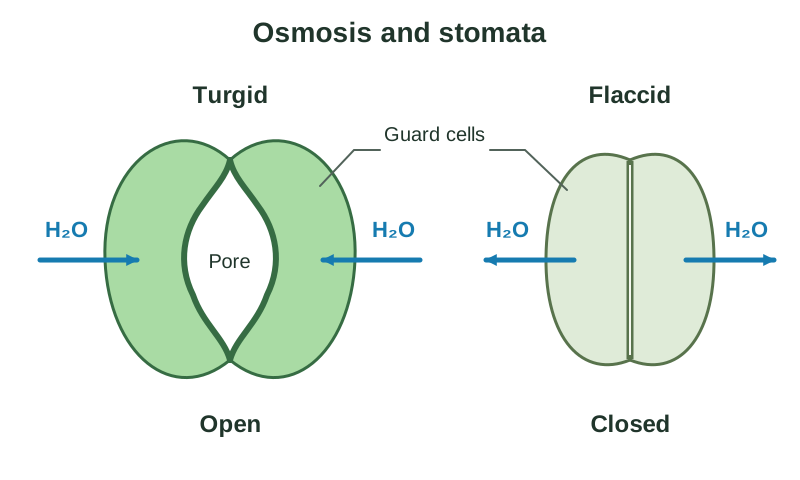
- Opening and closing stomata: Guard cells flank each stoma on a leaf. When they absorb water by osmosis, they become turgid, curve outward, and open the pore for gas exchange. When water is scarce, they lose water by osmosis, turn flaccid, and close the pore to stop water loss.
Osmosis in Food Preservation
Salt and sugar are not chemical poisons. Instead, they preserve food using simple osmotic dehydration:
- Meat or fish is packed in dry salt, or fruit is boiled in concentrated sugar syrup to make jam.
- The high solute concentration creates a hypertonic environment around any bacteria or fungi that land on the food.
- Water leaves the microbial cells by osmosis. Without enough water inside their cytoplasm, their enzymes stop working, so the microbes cannot grow or reproduce, and the food stays fresh.
Investigating Factors Affecting Rates of Osmosis
The specification requires you to investigate how temperature, concentration gradient, and surface area affect the rate of osmosis across a semi-permeable membrane, and to support your conclusions using primary data.
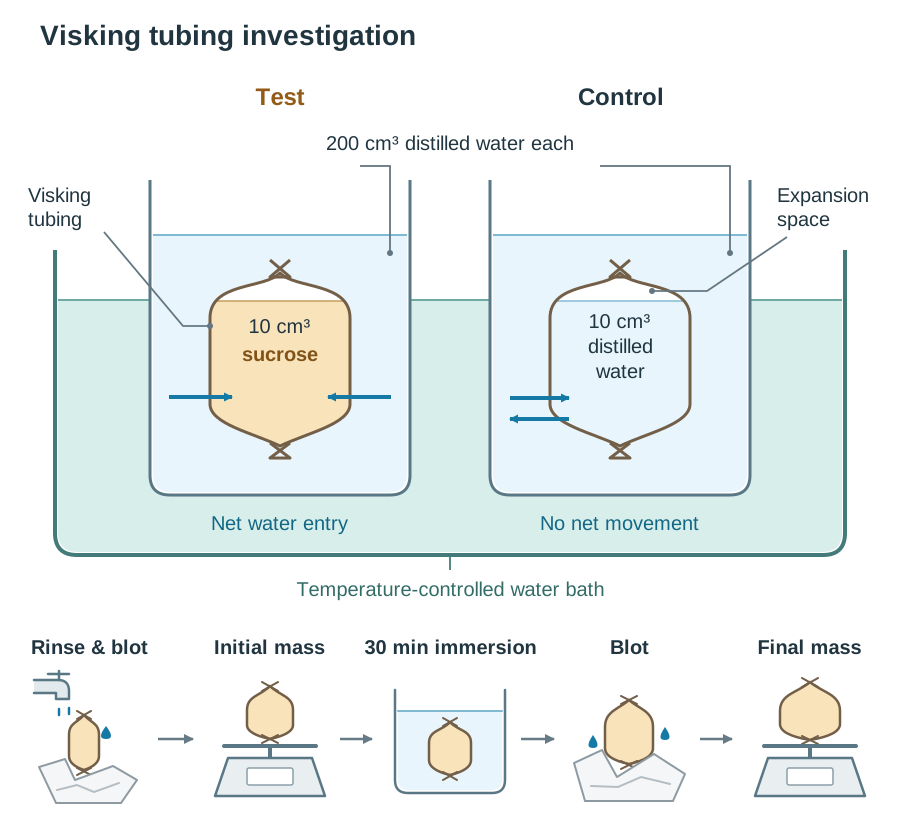
Experimental Setup and Controls
- Hypothesis: As the concentration gradient increases, the rate of osmosis into Visking tubing increases.
- Independent variable: The factor you change systematically (for example, sucrose concentrations of 0%, 5%, 10%, and 20%).
- Dependent variable: The percentage change in mass over a set period.
- Controlled variables: Water bath temperature, time immersed (30 minutes), starting volume inside the tube (), and outside volume of distilled water ().
- Experimental control: A Visking tube filled with distilled water placed into a beaker of distilled water. It should show zero mass change, proving that mass gains in the sucrose-filled tubes come from osmosis driven by solute, not by the tubing absorbing water.
- Repeats: Run three tubes for each sucrose concentration and calculate the mean to reduce the effect of random errors.
Laboratory Steps for Visking Tubing
- Soak lengths of Visking tubing in water to soften them, then tie a tight knot at one end of each.
- Add of sucrose solution into each Visking tube, and of distilled water into the control tube.
- Knot the open ends securely, leaving a small air space so the tube can expand.
- Rinse the outside of every tube with tap water to wash away any spilled sucrose. Sucrose left on the outside adds to the starting mass and then dissolves into the beaker, making the measured gain too small. Rinsing and blotting prevent this.
- Weigh each tube on an electronic balance and record the starting mass.
- Submerge the tubes in beakers of distilled water for exactly 30 minutes.
- Remove the tubes, blot the outside carefully to remove surface water droplets, and weigh them again.
Testing the Three Factors
- Concentration gradient: Test 0% (control), 5%, 10%, and 20% sucrose inside tubes immersed in pure water. A steeper gradient produces a faster net entry of water.
- Temperature: Place identical 10% sucrose tubes into water baths at 10°C, 25°C, and 40°C. Warmer temperatures give water molecules more kinetic energy, speeding up their movement across the membrane.
- Surface area: Keep the volume and concentration of sucrose identical, but alter the exposed membrane area (for instance, compare a short wide tube against a long narrow tube). More surface area provides more entry points, raising the rate of osmosis.
Potato cylinder method: You can also cut equal-sized potato cylinders using a cork borer, blot them dry, record their starting mass, and leave them in different sucrose solutions for 60 minutes. The sucrose concentration where a potato cylinder shows 0% mass change matches the solute concentration inside the potato cell sap.
Data Analysis, Calculations, and Evaluating Errors
Because pieces of tubing or potato cylinders never start with identical masses, raw mass gains cannot be compared fairly. Calculating the percentage change in mass standardises your data:
To find the rate of osmosis:
Sample Calculation
A tube holding 10% sucrose has an initial mass of 12.0 g. After 30 minutes in distilled water, its final mass is 13.5 g.
Suppose your primary results look like this:
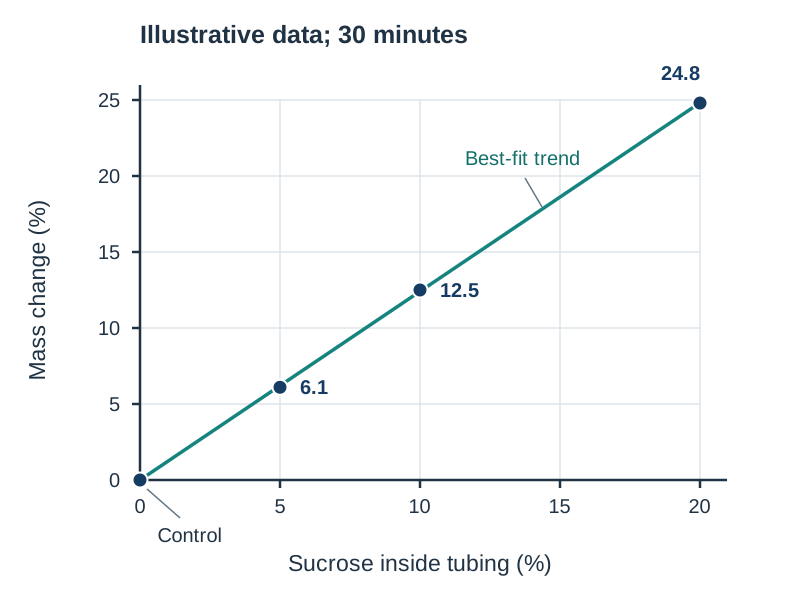
- 0% sucrose (control): 0.0% change
- 5% sucrose: +6.1% change
- 10% sucrose: +12.5% change
- 20% sucrose: +24.8% change
Plotting percentage change on the vertical axis against sucrose concentration on the horizontal axis gives a roughly straight line rising from the origin. As the concentration gradient increases, the percentage gain in mass increases in proportion, which supports your hypothesis.
Evaluating Experimental Quality and Errors
When evaluating data, two distinct concepts describe measurement quality:
- Accurate: close to the true value.
- Precise: repeated readings are close to each other.
Dealing with Errors
- Random errors vary unpredictably from one trial to the next. Inconsistent blotting with paper towels or small shifts in water bath temperature are typical examples. Running three repeats and taking a mean smooths out their impact.
- Systematic errors shift readings consistently in one direction. For example, a balance that was not zeroed (tared) makes every mass reading too high or too low. Reduce them by checking and zeroing equipment.
- An anomalous result is an outlier that sits well away from the pattern (such as a tube gaining only 1.5% at 20% sucrose because of a leaky knot). You should discard an anomaly when calculating your mean and note the likely reason in your investigative log.
Key terms
- Diffusion
- The spreading out of particles from an area of higher concentration to an area of lower concentration down a concentration gradient.
- Osmosis
- The movement of water molecules from a region of high water concentration to a region of low water concentration across a semi-permeable (or selectively permeable) membrane.
- Active Transport
- The movement of molecules or ions across a cell membrane against a concentration gradient, using carrier proteins and energy from ATP.
- Concentration Gradient
- The difference in the concentration of a substance between two regions.
- Semi-Permeable Membrane
- A membrane that lets small molecules like water pass through freely while blocking larger solute molecules.
- Selectively Permeable
- A property of living cell membranes that regulates the passage of substances through specific transport proteins.
- Turgor Pressure
- The outward force exerted by the cytoplasm and swollen vacuole against the plant cell wall.
- Plasmolysis
- The shrinking of plant cell cytoplasm away from the cell wall when water is lost by osmosis.
- Hypotonic Solution
- A solution that has a lower solute concentration (and therefore a higher water concentration) than the cytoplasm of a cell placed in it.
- Hypertonic Solution
- A solution that has a higher solute concentration (and therefore a lower water concentration) than the cytoplasm of a cell placed in it.
- Isotonic Solution
- A solution that has the same solute and water concentration as the cytoplasm of a cell placed in it.
- Lysis
- The bursting of an animal cell caused by excessive intake of water by osmosis in a hypotonic solution.
- Crenation
- The wrinkling and shrivelling of an animal cell caused by water loss through osmosis in a hypertonic solution.
Check yourself
Why is the cell membrane described as a 'fluid mosaic'?
It is called 'fluid' because phospholipids and proteins move laterally within the bilayer, and a 'mosaic' because proteins are scattered throughout the lipid layer.
What happens to a red blood cell placed in distilled water, and why does an onion epidermal cell not share this fate?
The red blood cell bursts (lysis) because water enters by osmosis and it lacks a cell wall. The onion cell becomes turgid without bursting because its tough cellulose wall resists the internal pressure.
How does adding an excessive amount of chemical fertiliser to soil cause a garden plant to wilt?
Excess fertiliser makes the soil water hypertonic to the root cell sap. Water leaves the root cells by osmosis, causing them to lose turgor and become flaccid, which makes the plant wilt.
Why does cutting a potato tissue block into four pieces increase the rate of mass change during an osmosis experiment?
Cutting the tissue into smaller pieces increases the total surface area of membrane exposed to the solution, allowing more water molecules to cross by osmosis per minute.
Why must Visking tubing be thoroughly rinsed with water before its initial mass is recorded in an osmosis experiment?
Rinsing removes any sucrose solution spilled onto the outside surface during filling, preventing it from inflating starting mass and dissolving into the beaker water, which would reduce the measured gain.